
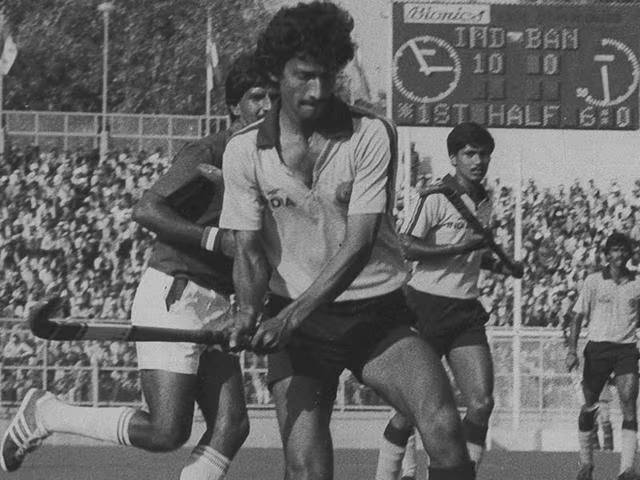

“The holiest city of the Hindus gave rise to the Mohammed of Indian Hockey” Sundeep Misra.
There are men who tread the path of convention, whose gait upon the field adheres to the dictates of structure and discipline, and then, there are those rare souls who dance to a tune of their own making, whose very presence bends the elements of the game to their will. Mohammed Shahid belonged, unequivocally, to the latter.
He was a celestial actor upon the stage of destiny, a maestro whose stickwork spoke in whispered enchantments and left spectators spellbound and adversaries grasping at shadows. His performance upon our sacred grass was an invocation and a ritual that turned hockey into a divine expression.
It is often said that sport is the theatre of the unexpected. But Shahid did not merely partake in this spectacle. He was its very essence. If hockey were an ancient epic, he was its most luminous protagonist like the battle-hardened warriors of the Mahabharata where fate and skill converged under the celestial gaze.

Defenders, those gallant knights of the opposition were oft left in his wake and their pursuits as futile as grasping at the wind. He was a phantom and a will-o’-the-wisp, who vanished before one could lay a hand upon his ethereal form. He relished victory as any warrior would, yet, it was the artistry, the exquisite execution of skill that truly set his soul alight. His hockey stick was his bow, his arrows were the deft movements that bewildered the foe, and like Arjuna in the grand battle of Kurukshetra, his was an act of divine ordainment.
To witness Mohammed Shahid in motion was to glimpse a rare confluence of mythology and modernity where the battlefield of Kurukshetra met the green expanse of the hockey turf. But beyond the echoes of ancient heroism, his legacy was inscribed in the chronicles of the sport as a maestro whose artistry defied time.
In the procès-verbal of field hockey, Mohammed Shahid’s name is etched in golden letters like a script woven with dribbles as delicate as the calligraphy of an ancient manuscript. If the game itself were an epic poem, Shahid would be its most enigmatic stanza—his movements on the turf forming an allegory of fluidity, grace, and defiant artistry.
He was a poet with a stick who composed verses with every nimble touch of the ball, his dribble a lyrical protest against the mechanization of modern hockey.
In literature, Harold Bloom speaks of the ‘anxiety of influence’ and how great writers wrestle with their predecessors to forge originality. Shahid, too, entered a pantheon dominated by Dhyan Chand’s ethereal control and Balbir Singh’s brute force.
But rather than succumb to the shadows of these legends, he inscribed his own scripture in the sport’s evolving tradition. His dribbling was his authorship and a signature so distinct that defenders, like perplexed readers before an experimental novel, struggled to decode his intent.
His famous ‘half push-half hit’ was an aesthetic breakthrough and a stylistic deviation as revolutionary as Dostoevsky’s psychological depth or Eliot’s fragmentation of poetic form.
Much like a literary innovator who redefines the very structure of narrative, Shahid transformed the grammar of hockey. Yes, his movements were skillful but more than that, they were expressive with each feint and glide a verse in the unfolding poetry of the play. If his predecessors had written the sacred texts of Indian hockey, he composed its modernist verse, unpredictable yet profoundly resonant.
To those who had the privilege of witnessing his splendour, Shahid remains a human experience encapsulated in endless emotions. He galloped upon the field with the air of an unbridled stallion, unfettered by the constraints of rigid tactics, his dribbles the strokes of an artist painting upon an ever-shifting canvas. The game was his stage, and like the celebrated characters of Islamic and Hindu lore, he embraced the destiny laid before him.
There was an almost divine poetry to his game and a cadence that lifted the mundane into the realm of the celestial. When he moved, the ball clung to his stick as if bound by an unseen force, and before his pursuers could so much as draw breath, he had flitted past, and left behind nothing but crushed pride and bewildered sighs in his wake.
Shahid’s golden journey began with his first senior appearance in 1979 in a four-nation tournament in Kuala Lumpur. That same year, he made waves at the Junior World Cup in France. By 1980, he was part of the Indian team that won Olympic gold in Moscow, a feat etched into the memory of the nation. At the 1980 Champions Trophy in Karachi, he was named the Best Forward Player, a title few could contest. His mastery continued through the 1981–82 World Cup in Bombay and the 1982 Asian Games, where India claimed silver, and the 1984 Los Angeles Olympics.
He played his final Olympic Games at Seoul in 1988, and before that, led India as captain in 1985–86, also securing a bronze medal at the 1986 Asian Games. His stellar play at the 1986 Asian Games earned him a coveted place in the Asian All-Star Team. For his contributions, he was awarded the Arjuna Award (1980–81) and the Padma Shri (1986). But why not a Bharat Ratna, I ask and request the honorable President of India.
Shahid’s influence was deeply philosophical than it was technical. He belonged to the sacred city of Benares where the Ganges flows like time itself and carries the weight of civilizations, faiths, and histories. To be a Muslim artist in a predominantly Hindu cultural landscape is to negotiate a delicate duality like Shahid did in his career. The Quran speaks of movement as an act of faith, and Shahid’s dribbling embodied a spiritual transcendence—each feint a whisper of divine geometry, each run down the flank a pilgrimage towards creative fulfillment.
In this, he was both heir and disruptor who echoed yet reshaping the subcontinent’s hockey tradition. Like any true artist, Shahid’s genius was deeply misunderstood in his time. The world shifted to the rigid tempos of Astroturf if only to favour power over poetry, system over spontaneity.
The game lost its touch, its improvisational beauty, and in doing so, perhaps lost something of Shahid himself. He was the last great romantic of Indian hockey, the final verse of an unwritten poem whose echoes still resound in every aspiring player’s dream.
His was a soul deeply rooted in the rhythms of his birthplace where the sacred and the temporal coalesced like the ripples of the Ganges. His dribbling was a meditation, his movement a prayer, and beyond the roaring stadiums, his heart remained tethered to the city that shaped him.

Yet, for all his romance with the sport, it was said that his heart belonged to another. The city of Benares. One cannot speak of Shahid without invoking the name of that most ancient and venerable abode where time flows like the sacred Ganges, unhurried yet eternal. It was here, upon the grand stage of civilization, that he played his second role like a mystic entwined in the currents of faith and memory.
Like the revered figures of Islam who sought the path of righteousness amid a world teeming with illusion, Shahid too sought his truth, not upon the battlefield of swords, but upon the expanse of green where hockey sticks clashed and destinies were forged. If hockey was his jihad, Benares was his Medina, the land where his spirit found solace amidst the hustle and clamour of mortal pursuits. It was here, in the holy embrace of this city, that the Mohammed of Indian hockey found his true self.
In an age where sport is increasingly reduced to numbers, Shahid reminds us that true greatness defies quantification. Like a literary classic, his brilliance cannot be measured in mere victories but in the ineffable impact he left on the soul of the game.
His dribbling was a philosophy, a text written on the green fields of history—a text that, like all great literature, will never fade. Cognitive biases, those unseen stage props that shape the perception of religion and belief, wove their spell over the audience. To some, he was but a fleeting talent; to others, he was a prophet of the game, delivering revelations with every touch of his stick.
The belief in immortality, the yearning to witness legends beyond their time, cast him as a figure of both nostalgia and transcendence. He was both a mortal player and a celestial actor, one whose legend is shaped by the grand theatre of perception.
Yet, legends are not bound by the cold arithmetic of history; they live on in the myths they inspire, the echoes they leave behind. And if perception shaped Shahid’s immortality, then memory ensured it—cradling his brilliance like an eternal refrain, sung from one generation to the next.
It is the fate of all mortals to be confined to the annals of memory, yet some men defy even time itself, their legends passed down like sacred hymns. Shahid was one such enigma—his presence on the field akin to a comet streaking across the heavens, brief yet unforgettable, dazzling yet elusive.

He played not for numbers nor accolades but for the sheer joy of unfurling magic before a breathless audience. To witness him in his prime was to witness the divine at play, to see the impossible made manifest before one’s very eyes.
So, Where Is Mohammed Shahid Today?
In the deathless evening, I wrote a poem,
Not for the world to read, but for my Shahid
Whose name the winds of Benares forever chant
I dipped my pen in silence,
And let the ink ripple like the Ganges
Into a verse only midfield can rhyme.
Every syllable curved like his run on the flank,
Every pause, an echo of breathless awe.
For what is genius, if not
A light too bright to stay?
He is where artistry meets eternity. Somewhere between the happiest and the saddest, he lingers like a phantom flicker of genius on a field unseen, where the echoes of his stick against the ball still resonate through time. I find myself caught in the luminous stretch of his brilliance yet wrapped in the protracting shadow of his absence, yearning for one final feint, one last deceptive body swerve to defy even fate itself.
I am a fighter, yet willingly ensnared in the poetry of his play. I surrender to the unfinished sonnet he left behind where each verse dribbles between memory and longing. I remain garnished with hungering, a silent spectator in the terraces of nostalgia, faithful to the pulse of this moment—strong enough to etch his name in words, yet vulnerable enough to crave the echo of his voice, the rhythm of his run, and the dance of his blade upon the turf.
And as the game moves on reshaped by the tides of modernity, somewhere on a quiet, dusty field lost to the world, Shahid’s spirit stirs again. In the heart of a young dreamer, it awakens dancing past defenders, gliding through the corridors of memory.
And in that fleeting moment, it’s as if hockey returns to its soul, to Benares the city he loved more than life. There, where every narrow lane still whispers his name, the game becomes what it once was: poetry in motion, pure and eternal.
Follow Fieldvision on Youtube ,Twitter , Facebook Instagram and Whatsapp Channel for more updates.


Leave a Reply