


Six matches. Three goals scored. Ten conceded. One solitary point. No wins. For a club that once made the Indian Super League tremble, for a club whose supporters, the Manjappada, sacrifice weekends, family time and social lives just to fill the stands; the 2025–26 season, so far, was not a disappointment. It was a collapse.

David Catala left Kerala as the first coach in the club’s history never to win a league game. Weeks on from his departure, speaking to FieldVision’s Jeremy from Spain, the Catalan is composed, measured, and, when he chooses to be, remarkably direct. His account names no single villain. It doesn’t need to. The picture it paints is damning enough on its own.
‘The Situation Was Totally Different’
Even Catala does not attempt to dress up the numbers. He calls the record “very frustrating” and does not pretend otherwise. But he frames the catastrophe within a context that he insists those outside the dressing room could not fully see: a club that had quietly unravelled long before a ball was kicked this season.
“The situations that we had around the team, the financial situation, all the things that happen in the league; that made the team lose a lot of powerful options. It wasn’t easy to compete in the same condition as maybe in the previous years. That was totally different.”
He arrived in Kerala with genuine ambition. What he later had, he says, was a squad that bore almost no resemblance to the one he had been initially handed.
Mutual, But Not Painless
The club’s public statement described the parting as mutual. Catala confirms that version, but the word carries more weight than the press release implied. He wanted to stay. He believed his work was unfinished. But he could feel the confidence of the management draining away with each passing defeat, and he had the self-awareness to understand what that meant.
“The confidence about me was losing from the management. The results were not coming, and I thought that maybe the best idea for the club and for me, personally, was to appoint another coach. Finally, we agree mutually that the best way for the future of the club was to separate our ways.”
It is a resignation dressed up as a negotiation. He accepts it without bitterness. “For sure, I’m gonna be better coach after this experience in Kerala,” he says — and it sounds less like a platitude than a quiet, private resolution.
‘You Have to Ask the Club Why They Didn’t Tell the Fans the Truth’
When Catala said publicly, early in the season, that Kerala Blasters were “living in a different reality” and could not compete for the top, the backlash was fierce. Pundits called it defeatist. Fans felt betrayed. He was accused of setting the table for failure before a fork had been lifted. Asked now whether those words were misunderstood, he does not retreat an inch.
“The foreign players that came here came with zero salary. They are not earning nothing. With a lower profile of players, the players didn’t receive or didn’t get salaries. This was the situation of the club. If the committee (management) doesn’t want to explain openly what is happening right now — it is like that (the reality). I didn’t want to lie anyone.”
He was not making excuses, he says. He was stating facts. The real question, as he sees it, is not why he spoke; but why the club chose to stay silent while its own coach was being pilloried for telling the truth.
Back Five, Back Four, Back Three; And the Trap in Every Question
Data analysts who tracked Kerala’s season logged a bewildering rotation of systems; back five, back four, back three, with corresponding reshuffles in midfield and attack. The criticism that followed was predictable: the team had no identity, no plan, no spine. Catala has heard it all. He also knows exactly what the counter-argument would have been had he stayed rigid.

“When the results are not coming, you are gonna get criticized all the time. If you are not winning games and you change the tactics, they will say why you are changing all the time. If you don’t change the tactics and you are losing games, for sure, your question would be why you didn’t try a different way of playing. I’m pretty sure the question would be like this.”
There is an uncomfortable logic to that. A coach without results is wrong whatever he does. What Catala does not say, but what lingers between the lines, is that no system was ever going to paper over the fundamental deficiencies in the squad he was working with.
Playing Wide Because There Was No One in the Middle
The most repeated criticism from fans was brutally simple: the team looked lost in possession, the tactics amounted to little more than finding Kevin Yoke on the left and hoping for the best. Even when that pattern failed, repeatedly and visibly, it continued. Catala does not dispute it. But he reframes it as a structural problem rather than a tactical failure of imagination.
“I missed these quality players in the middle, that can move the team, penetrate lines, break lines.“
Moreover he added, “That’s why maybe we played more on the sides; to try to find one-against-one superiorities with the quality of Kevin, and Korou, that was basically the idea.”
He had wanted to play through the centre. The personnel, simply, would not allow it. And when Korou was dropped from the final games, the team’s last meaningful threat in the final third went with him. “The potential of the team was decreasing,” Catala says. It is one of the few moments in the interview where he sounds genuinely resigned.
‘I Am Not an Idiot. I Wanted to Keep All of Them.’
The departures of Aimen and Azhar, two of the more popular figures in the squad, were publicly framed as the new coach cleaning house, building his own group. It was a narrative that stuck, and it damaged Catala’s standing with supporters before his first competitive match. The truth, he says, is the opposite.
“This is another thing that you have to ask to the club. When I took the team in the last moment, the idea of the club was very simple: all the players that have any offer, they can leave. That’s why Aimen and Azhar left. That’s why Luna left. That’s why Noah left. That’s why Koldo left. That’s why Juan left. Dusan, Lagator left.”
He lists the names like a toll of the fallen, each one a player he wanted to keep. “I am not (an) idiot,” he says. “For me, the best thing was to keep Luna, to keep Noah, to keep Dusan, to keep Aimen and Azhar that they had in the previous season. It was my intention.” He chose to stand with the club rather than fight it; and the blame, by default, settled on him.
The Market No One Wants to Be In
With the financial situation as it was, recruitment became an exercise in impossibility. Catala was involved in identifying signings — “we were deciding which players was the best to come” — but the pool he and the management were fishing in was one most clubs would not go near. Players with no teams, no wages for months, and nothing to play for except the faint hope of future employment.
“It’s very difficult to bring players earning nothing. It’s very difficult to convince players to come to India, to a league, without taking salaries, and to get a good result. Believe me, that is very complicated.”
He is scrupulous about not blaming the management — “I think they are doing a very good job” — but the bewilderment beneath that generosity is clear. The club’s stated target, he confirms without any hint of embarrassment, was not the playoffs, not a top-six finish. It was to stay in the ISL for another year, without getting relegated. “The matter is to survive this season. Nothing else.” As for the recently signed Karim Benarif — a name that emerged just as Catala was leaving — he is unambiguous: “No, no, it was not by me. I don’t know.”
‘No, No, Nothing. No Salary.’
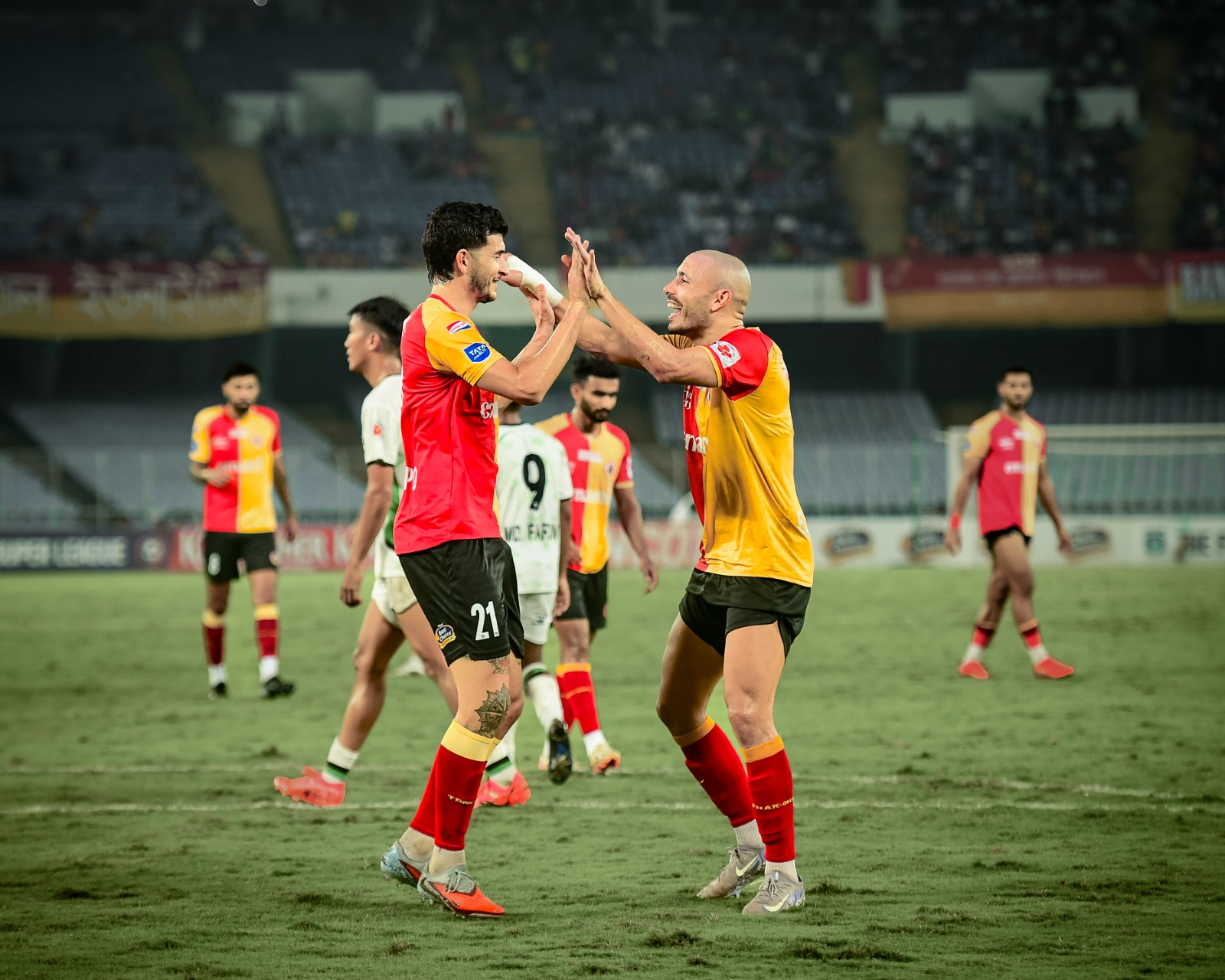
When comparing the squad that beat East Bengal 2-0 in the Super Cup to the one that lost to Punjab on the final day under his watch, Catala doesn’t bother searching for diplomatic language. The difference, he says, comes down to one thing. He reaches for a comparison that is almost disarmingly blunt.
“If you pay one player five and another player zero, the normal thing is that the player you pay five is going to be better than the player you pay zero. If you want to buy a computer that costs 1000, it’s going to be better than one that costs 25.“
He is quick to say his new recruits were professional, committed, hard-working. But he will not pretend they were the same level as the players they replaced. “We cannot compare the squad one year ago with this squad.” And when pressed on whether “zero salary” was literally what it sounded like, whether these players were truly playing for nothing, the answer is delivered in four flat words: “No, no, nothing. No salary.”
‘I Don’t Know Why They Don’t Give the Information’
After the loss to Chennai, Catala was asked directly on camera whether he had the full backing of management. His answer, “I don’t know. Maybe you must ask other people”, set off a week of speculation. Here, he closes it down. The relationship with director Nikhil, CEO Abhik and sporting director Karolis was, he insists, consistently respectful. He cut his own salary to take the job. He harbours no grudges.
“Always the relationship with them was good. They know that I made a big sacrifice to come here, reducing a lot my salary. I took the risk to reduce my salary because I wanted to live this experience. They respect my work all the time and i respect their work all the time”

But the frustration that runs through everything else surfaces here too. The fans were not told what was really happening. Their expectations remained calibrated to a club that no longer existed. “I don’t know why the management doesn’t want to give all the information,” he says. But he ends with empathy for the management: “They are suffering as well. They are receiving a lot of criticism, and they are suffering a lot about that. I think they are good guys.”
Five Months Without a Club — And Still They Came
The question of how you convince a professional footballer to cross the world for no money reveals just how fragile the architecture of this season truly was. The club’s pitch was not a contract. It was an argument; that two or three months of competitive football in the ISL, however modest the terms, was better than sitting at home.
“We took players that were not competing in any league, not in any teams, just to take these two or three months as an opportunity for them to make a good season, and maybe in the future, to get a good contract here in India or to open market in different countries. Some of them, maybe even five months without training in any team.”
For some, the gamble paid off in terms of exposure. For the team, it created a squad of footballers who were rusty, unfamiliar with Indian conditions, and had no leverage whatsoever. That Kerala Blasters competed at all, in six of those matches, is in retrospect something close to remarkable.
A Dressing Room Without a General
Catala openly admits that his team lacked a natural leader. It was missing the one figure who could hold the dressing room together when things went wrong. Catala reflects on it with an honesty that is quietly painful.
“I miss this kind of character of leadership inside the pitch, who can lead the players. They are very good guys, very good players, very good professionals. But it’s true that I miss this kind of player that can have this leadership; even outside the pitch. Sometimes when the situation is not good inside the dressing room, to try to speak, one to each other. Sometimes I think the coach cannot do this, and maybe the players need to do this kind of meetings by themselves.”
There is a dressing room portrait buried in that answer. Players who did what was asked of them, trained without complaint, turned up without pay, but who, when the ceiling fell in, lacked the collective voice to hold themselves together. Every squad needs someone who speaks when the coach has left the room. Kerala’s did not have one.
While Chinta Faced the Cameras, Catala Was Already Saying Goodbye
After the defeat to Punjab FC, his last game in charge, Catala was nowhere to be seen in the post-match press conference. His assistant Chinta took the chair instead. For fans watching at home, it looked like a man unable to face the music. The reality was more mundane and, in its way, sadder.
“It wasn’t my decision. I didn’t even know that Chinta was doing the press conference. It’s because I had the meeting with the management about my situation, and we were discussing that after the game. I have a lot of respect for the media. I didn’t have any problem to show my face after the defeat, because it’s my job.”

While his team processed the loss in the dressing room, Catala was in a different room, in a different kind of conversation; negotiating the terms of an ending that both sides already knew was coming. By the time the room was finally empty, it was too late for a press conference. The season was already over.
To the Fans Who Gave Everything
Of all the questions in the interview, this one carries the most personal weight. The Manjappada; the yellow wall of noise that makes Jawaharlal Nehru Stadium one of the most electric atmospheres in Asian football were part of the reason Catala wanted this job. He had watched the videos. He had seen what the stadium looked like full.
“I wanted to live the scenarios that I watched in video about previous years, with the stadium full of people supporting the team. That was one of my reasons to sign here.”
He expresses gratitude. He wonders aloud whether the fans were given enough information by the club to calibrate their expectations. But an outright apology never comes. Perhaps because he doesn’t believe the failure was entirely his to own. Perhaps because, on the evidence of everything he has said in this interview, it wasn’t.
Survival First. Then, Maybe, Something Better.
For Catala personally, the road ahead is unclear. There is no announcement to make, no next chapter to reveal. He calls the India experience “challenging and unfortunate” but frames it as education. He is a better coach for it. That, at least, is something.
“About the club; wish them all the best to win the titles. But I repeat, I don’t know how much time it takes for the team to compete. Hopefully sooner than later, to survive this season and after, to try to build again the team.”
It is a modest wish from a man who arrived with bigger ones. And it raises the question that the entire Kerala Blasters fanbase now has to sit with: how long does rebuilding take when the foundation has been this badly damaged? Catala doesn’t know. Nobody at the club seems to know either. The only certainty is that the Manjappada, who sacrifice so much, season after season, simply to be present, deserve an answer far better than silence.
David Catala: A Story Not to be with the Blasters
David Catala came to Kerala Blasters with a dream of building something. He leaves as a footnote; the first coach in club history not to win a single league game. But read the full transcript of this interview, and the picture that emerges is more complex, more troubling, and in some ways more damning of the institution than of the individual.
The real question this interview raises is not whether Catala was the right coach. It is whether Kerala Blasters, one of the ISL’s founding clubs, blessed with arguably the most passionate fanbase in Indian football, was in any condition to be coached at all. Until the club addresses its finances honestly and publicly, new personnel and new beginnings may produce only a variation on the same painful story.
The Manjappada deserve better. And now, at least, they know why they didn’t get it.
Follow Fieldvision on Youtube ,Twitter , Facebook Instagram and Whatsapp Channel for more updates.

Leave a Reply