
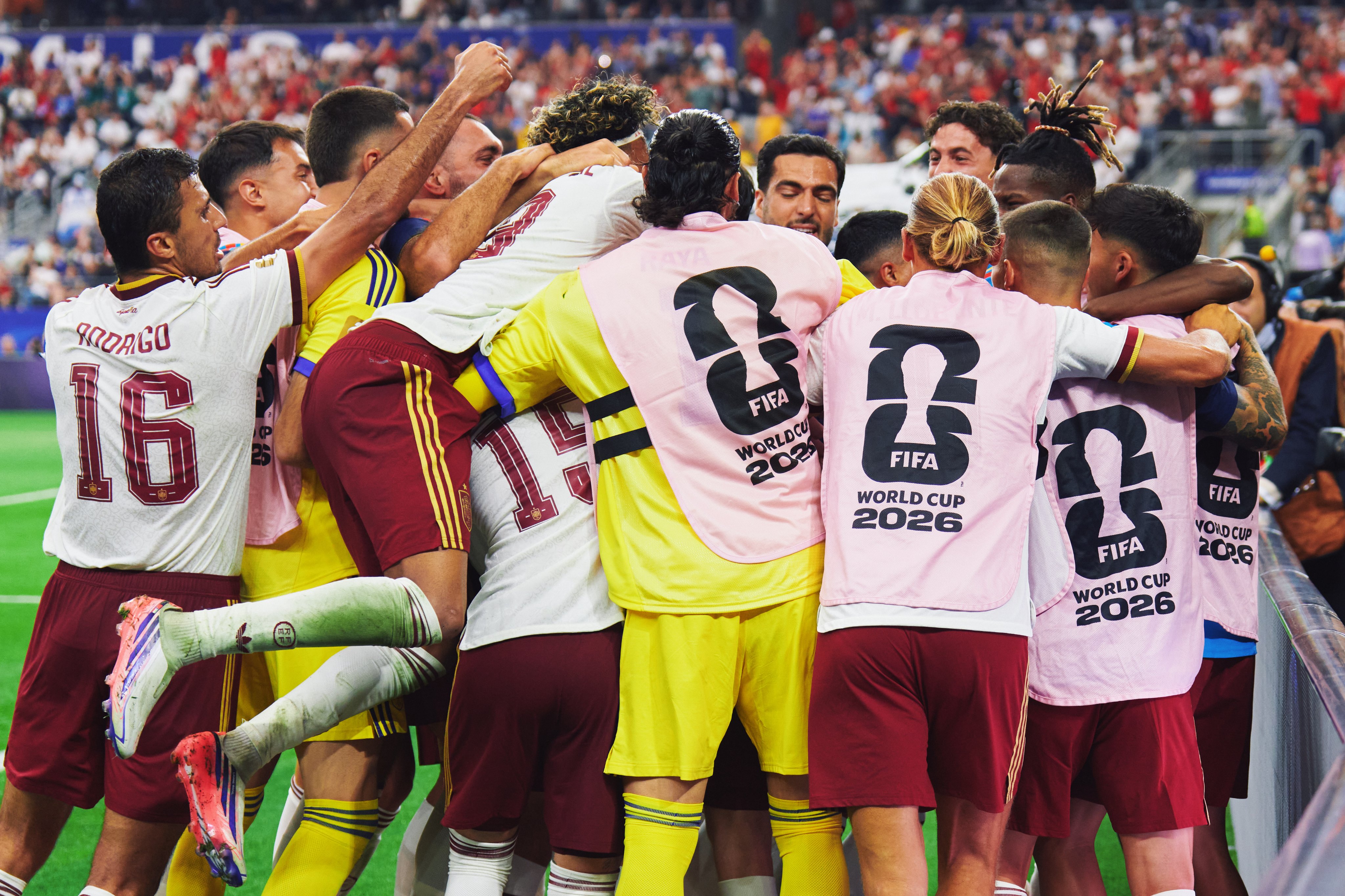
Football, in its truest and most poetic form, belongs to those who trust the collective. In the sweltering heat of the Dallas Stadium, Spain did not just defeat France 2-0 to book their ticket to the FIFA World Cup 2026 Final; they reminded the world of the beautiful game’s soul.
For months, the narrative surrounding Les Bleus has been dominated by individual brilliance. Every camera followed Kylian Mbappe; every headline anticipated a moment of singular genius that could shatter tactical frameworks. But as the final whistle blew in Texas, leaving the French giants looking despondent and hollowed out, it was the structural fluidity and unyielding brotherhood of La Roja that stood tall. Spain didn’t rely on a savior; they relied on each other.

A Masterclass in Brotherhood Over Brilliants
From the first whistle, France looked to explode in transitions, leaning heavily on the individual horsepower of Mbappe and Ousmane Dembele. Yet, what they encountered was an impenetrable, moving wall of red shirts. Whenever Mbappe isolated a defender, two more Spanish jerseys materialised from the shadows, executing perfectly timed covers. Marc Cucurella’s relentless, heroic tackle to deny Mbappe clean through on goal epitomised the selflessness of this squad.
Where France looked disconnected—eleven individuals operating in their own orbits—Spain woven a tapestry of intricate, devastatingly synchronized movement. Dani Olmo drifted between the lines like a ghost, Rodri held the center of the pitch with the calm authority of a maestro, and young Lamine Yamal played with an audacious joy that bypassed the physical intimidation of the French backline.
When Yamal drew a frantic challenge from Lucas Digne inside the penalty box in the 22nd minute, there was no anxiety. Mikel Oyarzabal stepped up, took a breath, and buried the ball past Mike Maignan with the absolute icy confidence of a team that knew their destiny.

The Chessboard: De La Fuente’s Triumph Over Deschamps
This historic evening will forever belong to Luis de la Fuente. For years, Didier Deschamps has prided himself on pragmatism, building a conservative, reactive French machine that absorbs pressure and punishes mistakes. But De la Fuente boldly tore up that playbook, out-thinking and out-maneuvering his counterpart at every turn.
De la Fuente’s masterstroke lay in his aggressive verticality. Rather than settling into the toothless, horizontal possession of Spanish eras past, La Roja attacked with a lethal, direct edge. They invited the French press just enough to open pockets of space, then sliced through them instantly.
The second goal was pure tactical poetry. In the 58th minute, Dani Olmo delivered a delicate, genius flick that unhinged the entire French defensive structure, perfectly meeting the bursting run of full-back Pedro Porro. Porro’s subsequent clinical strike into the bottom corner was not a lucky breakaway—it was a highly calculated geometric exploit that left Deschamps paralyzed on the touchline.
Deschamps threw on Rayan Cherki and Desire Doue in desperation, but De la Fuente countered by closing the spaces and suffocating the match with technical maturity. It was a tactical checkmate.

One Step Away from Immortality
As the Spanish players collapsed into tears and embraces at full time, the weight of their achievement began to settle. This 2-0 victory matches Italy’s legendary all-time European record of 37 matches unbeaten. More importantly, it cements this current crop of Spanish players as an authentic, historically great team.
On Sunday, either Argentina or England awaits them at the New York New Jersey Stadium. But if La Roja brings this exact harmony, this spiritual commitment to collective football, immortality is not just a possibility—it feels entirely inevitable.
Follow Fieldvision on Youtube ,Twitter , Facebook Instagram and Whatsapp Channel for more updates.



Leave a Reply