
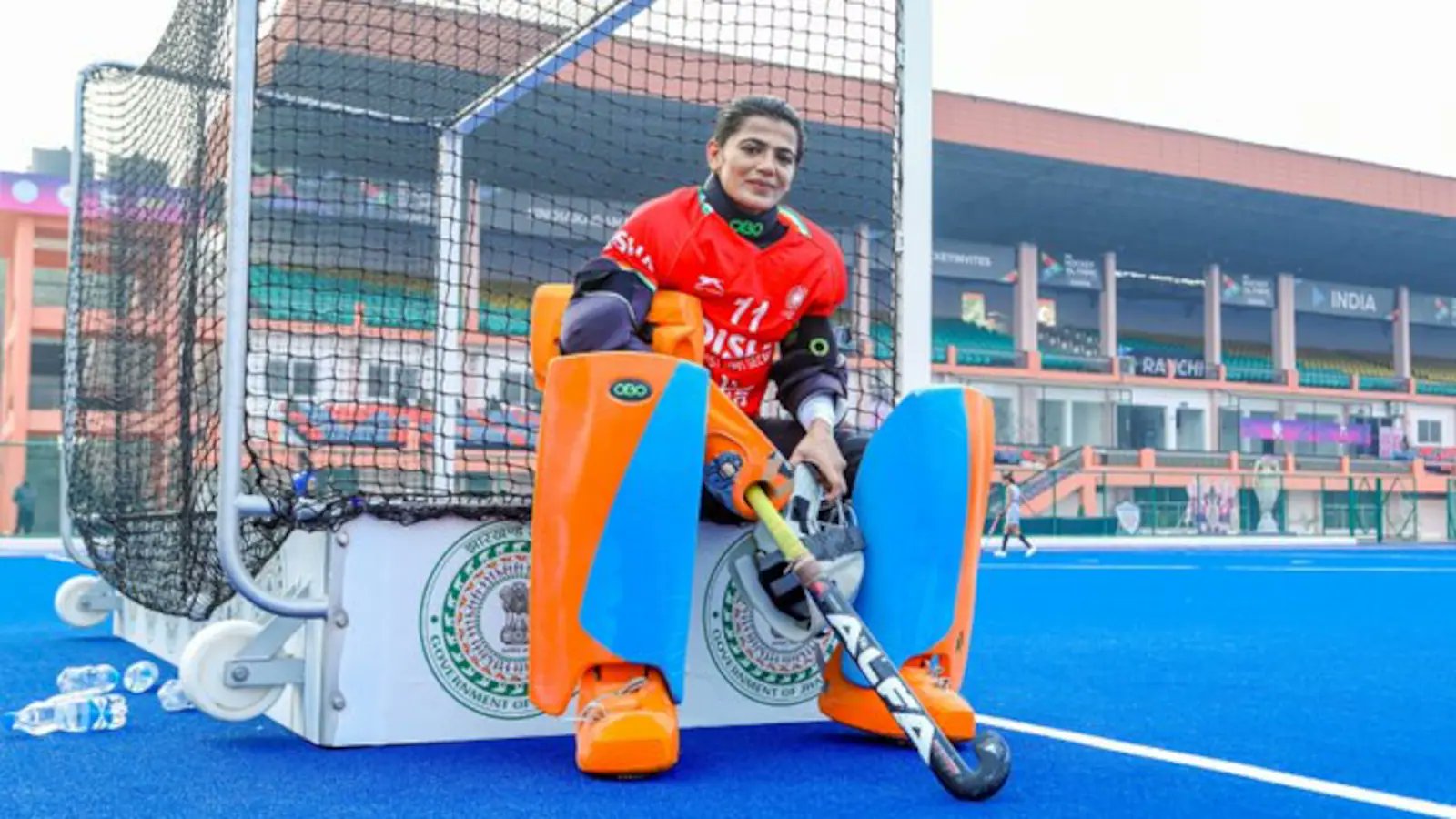
“The crowd sees the save. The goalkeeper sees everything that happened before it.”
From where I’m sitting, you cannot properly write about Savita Punia’s 321 international caps by placing the number beside her name and calling it a record. Yes, numbers have their uses in sport where we have become accustomed to reducing careers to appearances, goals, medals, rankings and percentages, but there are occasions when arithmetic becomes an inadequate language for the thing it is attempting to describe. To be fair, mathematics is the last preferred subject of mine, and, as a goalkeeper myself, I hardly ever took time to fall for them quantifiables. Three hundred and twenty-one international appearances tell us how often Savita has taken the field for India; they do not, by themselves, tell us what it means to spend that many matches in the most unforgiving position on a hockey field where the game may pass you by for several minutes and then, without ceremony, place the entire consequence of a defensive passage upon your gloves, your pads, your stick, your positioning and, above all, your judgement.

I say this as somebody who has spent enough time around hockey to be suspicious of the easy description of a goalkeeper as the last line of defence. It is a convenient phrase, and not entirely wrong, but it is technically incomplete. The goalkeeper is the last line only in the most obvious sense; tactically, she is also an organiser of the lines in front of her, an interpreter of the developing attack and, in many circumstances, the first player responsible for turning a defensive intervention into the beginning of the next phase. The goal may be behind her, but the entire field is in front of her. She therefore sees a different game from the one seen by the forward standing forty metres away. And this is where Savita’s 321 caps become interesting.
The rule book, as it must, gives the goalkeeper privileges which it does not extend to the ordinary field player. Inside the circle she is defending, a fully equipped goalkeeper may use the stick, kickers, leg guards, feet, legs and other parts of the body to stop or deflect the ball, subject of course to the restrictions governing dangerous play. Outside the circle, those privileges are considerably reduced, and is essentially subject to the ordinary field-player requirement of playing the ball with the stick. To somebody unfamiliar with the position this may appear to be a rather dry piece of regulation. To a goalkeeper, it is geography. The 23-metre area defines the territory in which her technical vocabulary changes. Inside the circle, she has options. Outside it, the law takes many of those options away.

Yet even within the circle, the law gives her means of intervention; it does not give her the right to be technically careless. A hand can stop a ball, but the question immediately becomes where that ball travels. A pad can make the save, but a rebound returned into the central channel may simply invite the next attacker to finish what the first one began. A goalkeeper can prevent the first shot and still fail to control the defensive passage. This is why, from a coaching point of view, I have always found the phrase “great save” rather inadequate unless one also asks the rather less glamorous question: what did the goalkeeper do with the ball after she saved it?
Savita’s career deserves to be examined through precisely these details, because goalkeeping is an occupation in which the public generally sees the consequence and the goalkeeper herself must live with the process. The spectator remembers the glove going up; the coach remembers the starting position. The spectator remembers the pad diverting the drag-flick; the technical eye is more interested in the angle that was taken away before the flick was even released. The crowd celebrates the intervention, quite rightly, but the goalkeeper’s craft has often been decided before the intervention becomes necessary.
This is why experienced goalkeeping can sometimes look deceptively simple. Because, the goalkeeper who arrives late has to make a spectacular save, and the goalkeeper who reads the play early may not appear to have done very much at all. From where I’m sitting, that second form of excellence is the more difficult one to appreciate.
Savita has spent her international career learning, relearning and refining that geography. Since making her senior international debut, she has passed through several generations of Indian women’s hockey, and the game she entered is not quite the game she has eventually helped to master. The speed of the international game has increased; penalty-corner batteries have become more sophisticated; drag-flickers have refined both release and variation; deflection structures have become more deliberate; and video analysis has changed the manner in which opponents prepare for one another. A goalkeeper who wishes to remain relevant through such a period cannot simply rely upon the reflexes that served her well as a younger player. She must evolve, and that, perhaps, is one of the less discussed achievements contained within 321 caps.
Longevity at international level is the ability to remain technically useful while the game around you changes, they say. It requires the goalkeeper to acquire new information without abandoning the instincts that made her an international goalkeeper in the first place. It requires her to understand that the striker she faced five years ago may now enter the circle with a different angle, release the ball earlier and expect the goalkeeper to have studied precisely that tendency.

In other words, experience does not simply mean that you have seen the same situation before. It means that you have seen enough variations of it to recognise what is different this time. And that is where the number 321 acquires its weight.
Because there is another aspect of goalkeeping which is rarely visible in the statistics and almost impossible to measure without having stood in the position yourself: anticipation. Reflexes are celebrated because they are dramatic; anticipation is often mistaken for instinct because, when it is done properly, it leaves very little evidence of the calculation that preceded it. Yet the goalkeeper is continually calculating. She is reading the body shape of the striker, the direction of the stick, the speed at which the ball is entering the circle, the position of the last defender, the possibility of a deflection and, perhaps most importantly, the space which must not be surrendered. By the time the shot arrives, much of the decision has already been made.
Penalty corners expose this better than almost any other situation in modern hockey. The goalkeeper has the protection of the equipment, certainly, but equipment does not remove uncertainty. The first task is to read the release, judge the line, remain balanced long enough not to be deceived by variation and then deal with whatever happens after the initial save. A goalkeeper may make the first intervention perfectly and still have a second problem arriving at her feet, across her body or through the traffic of players attempting to deflect the ball. The penalty corner is therefore a sequence of decisions compressed into seconds, and the quality of the goalkeeper is often revealed in the transition between those decisions.
From the pitch side, a clean strike gives information, but a deflection changes the information while the ball is already travelling. The angle becomes unstable, the reaction time contracts and the goalkeeper has to make a decision with incomplete knowledge. In such moments, technique and anticipation become almost indistinguishable.

This is where years in the goal begin to matter in a manner that a statistics sheet cannot easily explain. You begin to recognise the warning signs which precede the event. You recognise the forward who opens the stick face a fraction earlier, the attacker who delays the release because she wants the goalkeeper to commit, the penalty-corner variation in which the apparent striker is not necessarily the final striker, and the defensive movement which looks organised from outside but has left a small corridor somewhere inside the circle. To me, they are accumulated observations, stored somewhere between memory and muscle.
Savita has lived through enough of these moments for experience to become something more substantial than seniority. There is, after all, a difference between having played 321 matches and having carried the memory of 321 matches into the next one. The former is an appearance record. The latter is a goalkeeper’s education.
And perhaps this is also why the goalkeeper’s relationship with her defenders matters so much. She is the one player who can see the defensive structure in its entirety while the rest are occupied by the immediate contest in front of them. A defender may see the striker; Savita sees the striker, the passing lane, the second runner, the space behind the first defender and the possibility of what happens if the first intervention fails. Her communication therefore cannot be ornamental. It has to be early, precise and sufficiently authoritative to alter the behaviour of the players in front of her before the danger becomes visible to everybody else.
This is leadership in its least theatrical form. There is no applause for a goalkeeper who prevents a pass from ever reaching the dangerous area, because nothing has happened. There is no highlight package for the defender who closes a channel because the goalkeeper has warned her half a second earlier. But that absence of spectacle is precisely the point. Goalkeeping, at its most sophisticated, is an exercise in preventing the dramatic moment from becoming necessary.
And perhaps that is the most fitting way to understand Savita Punia’s 321 caps. They represent 321 international examinations of positioning, anticipation, communication, courage, recovery and judgement, across different teams, different opponents, different tactical systems and different versions of the game itself.
Follow Fieldvision on Youtube ,Twitter , Facebook Instagram and Whatsapp Channel for more updates.


Leave a Reply