
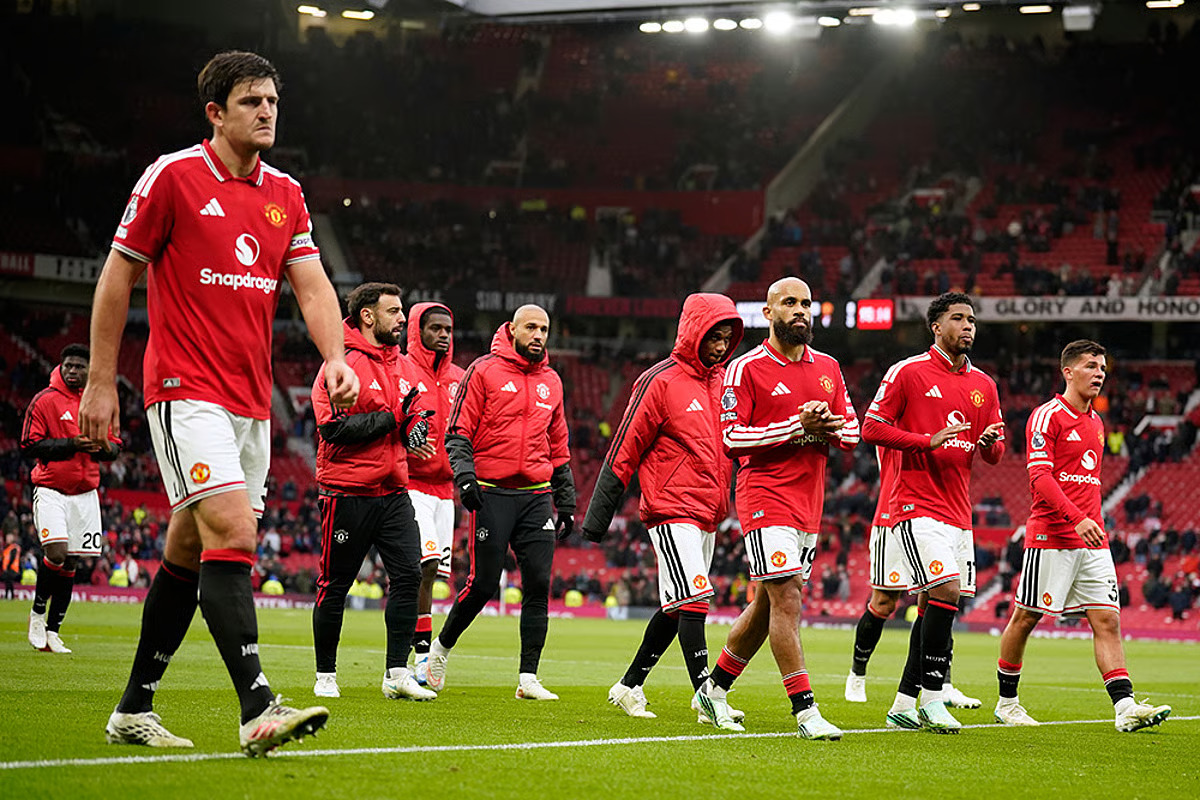
The ruin of a great house is among those melancholy truths of history which are seldom perceived by those who dwell within its walls. The walls must first grow cold, the hearth surrender its ancient dominion over the winter, and the familiar passages acquire that desolation which belongs to the lingering presence of what has departed. Only then does the inheritance disclose its true condition. The banners remain suspended, the titles are pronounced with customary reverence, and the chronicles of former triumphs are rehearsed as though remembrance possessed some secret power to stay the hand of time.
So it is with Manchester United, whose misfortune is rendered more grievous by the grandeur of the inheritance it has failed to sustain. There was a time when Old Trafford seemed a kingdom secure against the ordinary reversals of fortune, its theatre of football a place where courage, intelligence and collective purpose could turn adversity into legend. Yet kingdoms, like men, may outlive the substance of their dominion and mistake the ceremonies of sovereignty for sovereignty itself. And thus the winter advances, with the pitiless certainty of a Siberian frost, sealing one chamber after another, until those who inhabit the house discover that the warmth they remember belongs not to the present, but to the history of another generation.

For those of us who grew up watching Bryan Robson, Roy Keane, Paul Scholes and David Beckham, the present condition of Manchester United represents a disquieting estrangement from an institution whose identity once seemed unmistakable. Robson embodied courage that could carry a team through adversity; Keane made responsibility almost an uncompromising creed; Scholes possessed an intelligence that allowed him to govern the tempo of a contest without demanding its attention; and Beckham combined technical precision with a capacity to turn the ordinary delivery of a football into an event.
Nostalgia, however, is an unreliable judge when it becomes an excuse to avoid the present. Football has changed, its economics have expanded, and its tactical demands have grown increasingly sophisticated. The more serious question, however, is whether Manchester United has understood what made its former greatness possible, and whether its present custodians possess the institutional discipline to translate that inheritance into a coherent future.
This is where the fall of theatre outgrows its metaphors. The splendour of the building cannot compensate for a production without direction; celebrated performers cannot rescue a script that has lost its purpose; and publicity cannot indefinitely conceal the absence of artistic conviction. The distinction between possessing the instruments of greatness and understanding their proper use is precisely the distinction between maintaining a theatre and sustaining a performance.
Perception, in this context, is a prerogative when an institution’s reputation enables it to command attention, attract talent and shape the imagination of the sporting world. It becomes a hollow ritual when the preservation of that reputation degenerates into the repeated invocation of history, or when commercial strength is presented as evidence of sporting health. The institution continues to speak the language of greatness even as its performances struggle to substantiate the claim.
Paul Beekman Taylor, in Chaucer’s Chain of Love, writes of a pilgrimage moving eastward towards “beginnings and rebirths,” while recalling the westward march of rebellious peasants in 1381 as an act of resistance against “social chains of rank and privilege.” Pilgrimage implies the possibility of renewal through movement towards a renewed purpose; revolt challenges arrangements that have become intolerable or unjust. In football, renewal requires the willingness to reconsider inherited practices while resistance may take the form of refusing to accept prestige as a sufficient answer to persistent failure.
Nevill Coghill’s observation about Chaucer’s General Prologue is equally pertinent: “In all literature there is nothing that touches or resembles the Prologue.” He describes it as “the concise portrait of an entire nation,” encompassing people of different ages, professions, temperaments and moral dispositions. The enduring power of Chaucer’s portrait rests partly in its refusal to reduce a complicated social world to a single character or a convenient verdict.

A football club, too, is a society of competing responsibilities and unequal powers. And, any blame of failure on the manager is nothing but a mistake of the most visible figure on the stage for the entire company. A football club, too, is a society of competing responsibilities and unequal powers. To attribute its failures entirely to the manager is to mistake the most visible figure on the stage for the entire company. A theatre also falls when those entrusted with the production repeatedly fail to recognise the distance between their intentions and the experience they create.
Manchester United’s commercial stature makes this distinction very important. The persistence of global attention can create the impression that the institution remains secure, even when sporting coherence is in doubt. Yet commercial visibility and competitive authority are not interchangeable. The theatre may remain crowded; its name may continue to command recognition; its merchandise may travel across continents. None of these facts, by itself, answers the question of what is happening upon the pitch. Nor should supporters be expected to abandon their affection simply because disappointment has become familiar.
That is what Manchester United owes its history, and that is why its decline cuts so deeply. For those of us who grew up watching Robson, Keane, Scholes and Beckham, this is an anguish of watching a cherished inheritance being squandered, of seeing a great theatre surrender the majesty that once made it worthy of our devotion. My heart bleeds to witness its slow unravelling. The memories remain, but they have become a cruel measure of the present, each recollection of former greatness casting a longer shadow over what the club has become. I do not ask Manchester United to restore the past, for time grants no such reprieve. I ask only that it become worthy of the inheritance it continues to invoke.
Until then, Old Trafford will remain haunted by the echoes of its former magnificence, and those of us who loved what it once represented must watch the winter advance. Perhaps that is the deepest wound of all, not that a great theatre should fall, but that those entrusted with its keeping should allow it to happen. And when the final stones descend, I fear it will not be the sound of their falling that breaks my heart, but the knowledge that so much of what we loved could have been saved.
Follow Fieldvision on Youtube ,Twitter , Facebook Instagram and Whatsapp Channel for more updates.



Leave a Reply