
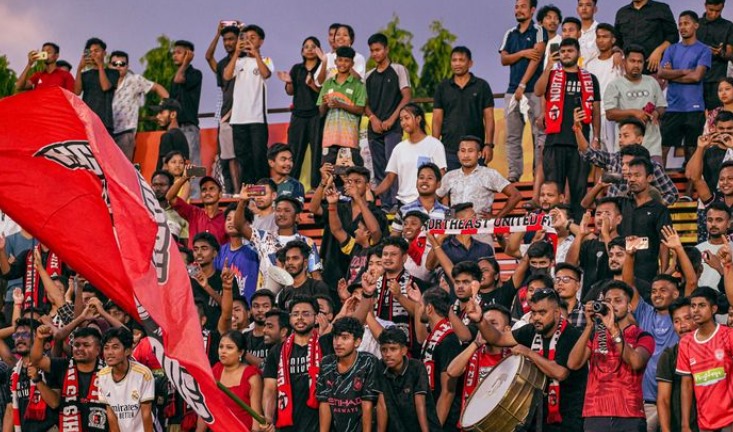

A NorthEast United FC fan Aashirwad Chakravarty pens a heartfelt tribute after their maiden Durand Trophy win.
The legendary former Liverpool manager Bill Shankly has quite often been quoted saying how football transcends the matters of life death. As a football fan, one can irrefutably relate to this, irrespective of allegiance to any club or nation. The identity of being a fan plays a crucial part in shaping our social realities. Nonetheless, it would not be a mistake to admit that the mundial spectacle grapples the hearts and minds of those who are amused by it.
From the streets of Brazil to the arenas in Europe, from the deserts of Africa to the tropics of the Indian subcontinent, the game has manifested itself as an undying and growing facet of our society. It is historic, euphoric, tribalistic, perhaps esoteric, but definitely hysterical.
I have been a fanatic of the game for more than 15 years now, and like most other people, plied my trade initially by engaging in European football- from reading news reports of my favourite team in England without any cable network, to watching them on live television later on. With the advent of modern technologies, we can now all relate in similar ways as we conform to the neo-liberal model of subscribing as a fan to various broadcasting networks, reading articles, watching highlights, and using social media, thus contributing to the reproduction of the habitus of football.

Even though Indian football had its inception during the colonial era, as Sports historian Kaushik Bandyopadhyay noted, the popularity of the game across India was battling the sudden surge in interest for Cricket, especially since 1983, and more so after the introduction of the Indian Premier League. However, it is there to be noted that the game had its claws deep into the hearts and minds of people from pockets of the Indian subcontinent such as Bengal, Goa, Kerala and the Northeastern region because of the erstwhile national league; the I-league. Club football grew across India which also naturally spread beyond the chicken-neck into the Highlands. Teams such as Shillong Lajong FC came to the forefront, challenging and hustling the other well-established historic clubs on the national platform.
However, Assam, the region I come from was yet to harness the potential of the game in a full-fledged manner. As a person born and brought up in Assam, I was perhaps only aware of Gilbertson Sangma, the mercurial forward who represented Assam in the Santosh Trophy and played for the Assam Police in the Bordoloi Trophy. Beyond him, perhaps many of us were unaware of the game’s significance, at least in my generation. It is only the stories of the past that widened our eyes, imagining the vogue it once had in the state.
While the other 6 sisters and the lone brother were already a hotbed of talent, cradling stalwarts of the game for the national team, Assam on the other hand, grappled with political turmoil, thus pushing the game to the shadows. Tackles were to be seen, but only off the pitch, concerning the very survival of the people. Cards were not red, but streets were. Pitches were not flooded, but houses were. Whistles were blowing, but along with sirens of curfews. Thus, an era passed by, where sports became a privileged leisure activity.

As the region crawled back up to relative normalcy, cultural events, especially sports came back into the public realm. However, as aforementioned, it was Cricket, and the impeccable timing of the national achievements and the emergence of the neo-liberalised model of the game that mesmerized the state. It would be a lie to state that kids in Assam were not fond of a certain knee-bending, guard-adjusting, little man who not just enthralled the spectators with his shots, but also moved many young ones into having nutritional drink every evening with milk.
Football was still in the shadows, undead, yet asleep. As cable TV arrived, one could see a drastic change in consumption practices and choices, as viewership of other sporting contents increased. Football started to rise back up from the shadows and enchant a generation of youths through the broadcast of European club games.
Allegiances started to form, rivalries started to emerge, as people living 9000 miles away were somehow relating to the identity of the clubs that they supported, consequently creating an ecosystem of eccentric exhilaration. Eventually, people started to yearn for a similar experience that they saw the local fans of European football had- inside the stadiums and out on the streets.
Localizing the game to create such spectacles became a subconscious dream, especially in Assam. The exuberance of the fans, the tifos, chants, pyros, and choreographies inside the stadium were elements of fan culture that some of us wanted to experience in person.
“Hello! Hello! Main Indian Super League bol raha hoon”
In 2014, a metamorphic change took place in the Indian football scenario. Franchise football emerged. Clubs were formed based on the region or the state, logos were developed, and spectators across India were smeared with new colours of the game. While this was seen with squinted eyes by many old-followers of the game, apprehensive of its consequential effects on the already established national league and its participants, for many others, this was a turning point. I remember being in the final year of my graduation when I read that the Northeastern region of India is to be represented in the Indian Super League under the broad collective franchise of NorthEast United Football Club (NEUFC). As I saw ownerships of other clubs in Abhishek Bachchan, Ranbir Kapoor, and even Sachin Tendulkar, I scrolled down the article to see who would be holding the beacon for the Highlands.

It was Mr. John Abraham. As I was still trying to understand the format and structure of the newly established league, I was, to be honest, not much moved by the celebrity endorsements that various clubs received. Perhaps this is how modern football had to step into the Indian households. We are, after all a country of movie-buffs. Bollywood stars elevated the game of Cricket previously, and were going to do so for Football as well.
Nonetheless, it was an exciting endeavor for me and most probably other football fans from Assam as well. What excited the people more was the involvement of European football stars in different franchises, such as Luis Garcia, Florent Malouda, Del Piero, Joan Capdevilla. The latter was picked up by NEUFC, thus drawing attention of many fans who have witnessed Spanish dominance in Europe and the World in the preceding years. Thus, started the first chapter of a sinusoidal set of experiences that the fans of North East United would be exposed to in the coming decade.
While the first season was a spectacle on the stands, the hype of the game did not live up to its name on the pitch. With underwhelming performances, the fans started to recede from the stadium, and discussions about the club and its crass performances began to be mumbled in the streets and across households. The first season in 2014 under Ricky Herbert saw us finish last, followed by a fifth placed finish even though we could see Portuguese star Simao play for us. The third season saw us play scintillating football under the tutelage of Nelo Vingada, with Emiliano Alfaro and The Nico Velez spearheading the attack. Yes, the same Velez, that some of the fans still want to see return to the club.
Unfortunately, NEUFC missed out on the play-offs by just two points. As hopes were raised, they were immediately squashed in the next season with a finish that would once again put us at the top of the table upside down. The trough followed by another crest, as the club brought in the enigmatic coach Eelco Schattorie, who put together the pieces of the puzzle to push the club into the play-offs of the ISL for the first time. After a forgettable season under Joao Carlos Pires de Deus and Avram Grant in the previous year, the 2017-18 season became a memorable one, not just for the club or the players, but also for the fans.

As I returned back home to Guwahati after packing my stuff from the cubicles of Kolkata, I witnessed the rise of an organised support in the form of the Highlander Brigade. I still remember, watching the game from the stands when I saw a bunch of people downstairs in the South-East stand of Sarusajai Stadium, Guwahati, waving flags, clapping, dancing, and singing for the team – something that I envisioned while watching football on TV. Without wasting any more time, I joined the euphoria at the stands, acquainted myself with the boys, thus becoming an excited, enthusiastic member of the Brigade.
As the season unfolded, we as the supporters’ group, and the only one at the time, were growing in quantity and quality alike. My hobby of singing and writing songs were put to use as I along with the fellow members came up with chants that soon became a part of the folk in the South-East stand. Tifos and banners were made, drumbeats were rolled, colours were smeared, scarves were flown, and the Highlander Brigade became the 12th person for the team, endearing the club, its players, coaches, and ownership.
There was a rising power in the hills, atleast in the form of organised fanaticism. We were gearing up for history, with Ogbeche, Borges, ‘Boot Jolokia’ Mascia and Senor Federico Gallego. Oh, Gallego! The magic that he weaved across the pitch soon enchanted the entire fanbase, making him the most loved, accepted, and endeared player to have donned the jersey. I even could not help myself writing a chant for him, on the tunes of “Popeye the Sailor man” which probably would be cancelled now, for having misogynistic undertones.
Federicooo Gallego
Federico Gallego
He can dribble and set up
For him girls wear make-up
Federicoooo Gallego!
We beat Bengaluru FC in the first leg of the play-offs with a stunning late goal by Mascia. However, as we marched onto the second leg, destiny had other plans. The team’s morale, the fans’ hopes were all derailed at the same time as Gallego was injured by Dimas and we were already missing Bart for the game. Thus, our maiden journey into the play-offs came to an end.
While we hoped for the club to capitalise on such a strong season, due to various precedented or unprecedented reasons, the following season saw Eelco depart along with many key players. Robert Jarni took charge, with Ghanaian International Asamoah Gyan joining the club, raising eyebrows of fans and rivals alike. Even though we started the season well, it ended on a sour note, thus falling down into another trough by finishing 9th.
The following season saw another wholesale change, and the lack of consistency started to irk many of us. The club felt lacking vision, structure, or a blueprint as we changed coaches and players quite frequently. The viewership fell down, with the owner gradually distancing himself from attending matches. Perhaps, he was apprehensive of facing the fans in person, or perhaps, misled by rumours and superstitious beliefs fed by the not so well-wishers within the club.
Nonetheless, the Brigade stood with the team, with its necessary criticism and demands of feedback. The club appointed Indian coach Khalid Jamil to take over from Gerard Nus’s team, which undoubtedly had enough calibre to usurp any other opposition on its day. As could be seen from the season that unfolded, we entered the play-offs once again, witnessing the brilliance of a young Apuia, alongside the tank Khassa Camara, infront of the duo of Dylan Fox and Benjamin Lambot. Wings were hot with Luis Machado, and the team was resolute in making sure that we finally get close to the dreams. But like Icarus from the Greek mythology, we perhaps flew too close to the Sun. It was not meant to be, once again. The home matches, the stadium rallies, and the away day support, all of which drove the team further, once again were not enough as we fell prey to ATK Mohun Bagan.
The following year under Khalid was once again a disaster as he failed to live up to the expectations and the club loomed in the doldrums. Two more coaches joined the club after him, failing to make any difference, all the while the talented youths demanding to move to greener pastures – for money, fame, and titles. For us, as fans, these days were darker than Sauron’s powers. Life felt dystopian for us all, and yet, we hung on. After all, the Brigade’s motto We Walk Through This Together was not something to be reduced to mere hashtags. We lived by it.
Enter, Juan Pedro Benali
When Senor Benali was announced, not many fans were excited. Some even joked that the club got Rafa Bentiez without the French beard. People were waiting to see consistency, not just in terms of performance but also the personnel. The 2023 season in ISL was underwhelming to say the least, but somehow deep down, we had the flame that was not meant to be put out. The league might have been not so encouraging, but the signs of a change were seen during the Durand Cup campaign, as we once again went to the semi-finals, only to be knocked out by East Bengal. Some of the players came under the spotlight for perfunctory attitude.
As the season ended, the club announced a change in structure once again, and for better. With the appointment of a new CEO, establishment of Club office in Guwahati, approaching stakeholders for youth setups, extension of contracts to key players and coaches, winds of change were felt. Without going overboard, we expected small steps to be taken by the club and in the right direction. The Guwahati Premier League was a testament to this change as the young guns put up a valorant display reaching the semi-finals, with crucial injury once again hampering the progress. The Durand Cup 2024 started with much required calmness and precision, which was well received and reflected by the fans. The group stage in Kokrajhar and the semi-final in Shillong proved to be a testament that the changes in the club has taken shape.
As we moved into the finals of the Cup, a maiden feat, many questioned about the quality of the opposition on the road to the final, and the mettle the club had when facing a team like Mohun Bagan Super Giants. Perhaps the occasion got the better of the team in the first half. But the second half wrote a story that would be passed down generations, and probably in the folklore of local footballing community.
I have only heard of the story of Istanbul where Liverpool FC’s heroics stunned the mighty AC Milan and the rest of the world. Watching the highlights, I used to speak with a fellow Brigade member, if and when we shall have such a moment. On 31st of August 2024, history was created. The coveted Durand Cup was lifted by the club, creating waves of euphoria. A comeback for ages. I saw fans kneeling down and crying, hugging each other, jumping in joy, running down the road yelling “North East! North East!”.
Perhaps, this is what dreams are made of. Perhaps, this is what we get at the end of the tunnel, if we persevere. The collective efforts of the club, the fans, and shades of individual brilliance by some who would even deserve a documentary of their career arc in NEUFC made this spectacle possible.
The feelings took days to sink in, as we spoke to each other questioning whether all of this is just a dream. If it is, we would never want to wake up, not even when September ends. A decade of countless memories, inexplicable emotions, and sinusoidal experiences brought us here. The Highlanders did it, the Wolves of Benali did it, the decade old fans did it. In the darkest of times, we walked through all of this together. This was a statement, that our hills were better than their castles.
(All the images used in the article including the cover photo is courtesy Mr. Aashirwad Chakaravarty and Highlander Brigade)

Leave a Reply to ManashCancel reply