
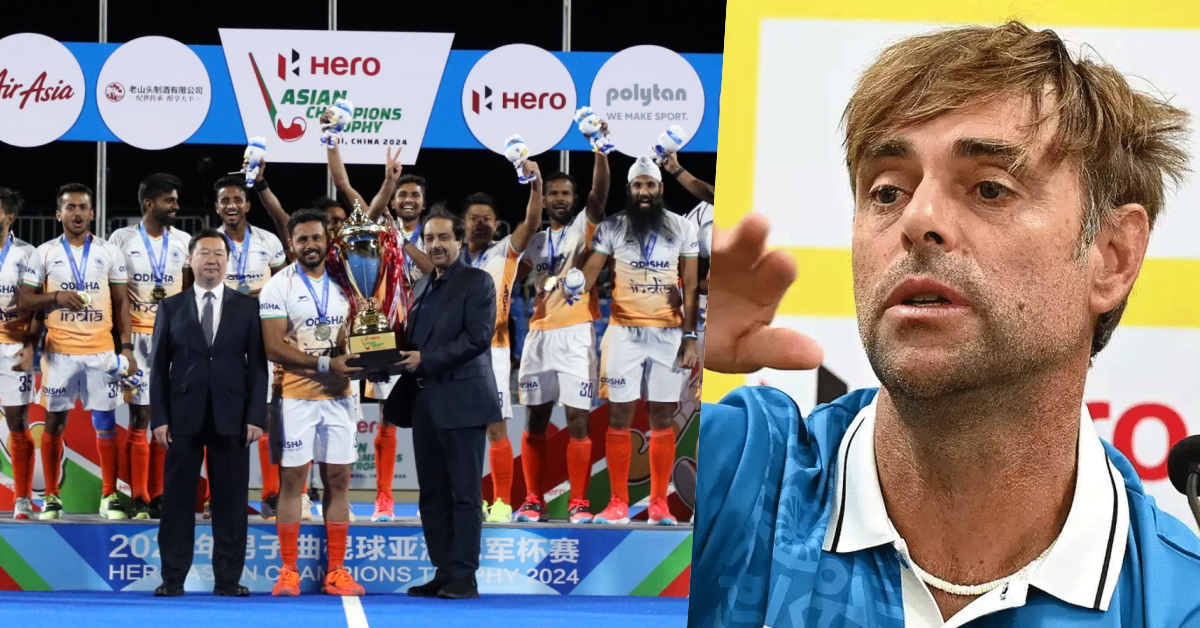

The Indian Men’s Hockey team successfully defended their Asian Champions Trophy title, defeating China at their own backyard in Inner Mongolia. This triumph capped off an impressive campaign, with India achieving a flawless 7 win streak. Let’s dive into the brilliance of India’s campaign. We will unravel the pattern behind their impressive success at Asia’s premier Hockey competition.
Build-up play
Differential Variation from Harmanpreet Singh during build up
Team India utilised a differential variation of build-up play from Harmanpreet Singh as a distributor. He distributes the ball to Nilakanta Sharma as a deep-lying midfielder. Nilakanta collects the ball and passes it to the inside-forwards. Vivek Sagar had been given the task to anchor the midfield in the central line.
Harmanpreet Singh was consistent in positioning and scanning. He provided support to the wing-back Jarmanpreet Singh. That support allowed Jarmanpreet to move ahead alongside. Singh, then formed a combination with the advanced forwards (Rajkumar Pal/Mohammad Raheel). Vivek held a crucial role in the central position. He helped India build overloads. He also shielded and carried the ball from dangerous zones. His skill sets are crucial in ball retention in crucial areas.
On the other hand, Manpreet Singh had been given a versatile role. This is different from his regular position as a deep-lying midfielder. His new role allows him to carry the ball from his own half.

Harmanpreet Singh as lone centre back
The second aspect is wide build up. It makes Harmanpreet the lone centre back in the move. This pushes other centre halves and wing backs up the field to support the single pivot. The single pivot gets pressed by aggressive forwards.
It’s essential to have more passing options close to the midfield in the opposition half. The wing backs push higher and combine with wide forwards (Abhishek/Araijeet). The forwards on the wide flanks attract the opposition press towards them. This movement creates space for wing backs and inside forwards to drive into the space in the shooting circle. It also creates more dribbling opportunities and positions to shoot.

Harmanpreet Singh as the ball carrier
The third aspect is Harmanpreet Singh’s ability to move as a midfielder and act as the ball carrier. He uses the switch plays to break the defensive lines. India has tried varieties of build-up play against compact backlines in Asia, implementing superior technical skills.
The opponents are not going to press the centre halves high up the pitch. India has to continue with a problem-solving mentality to break the blockages.
Pressing
India has tried variations of pressing instead of being too direct with full court press. They also have not been too pragmatic with half court and 3/4th press moves. Craig Fulton’s men have utilised differential pressing triggers as explained in the image below.

As you can see, Sukhjeet Singh opted to press the central defender. Indian players closed on to the ball carrier as soon as the Malaysian defenders approached the central line. So, the Malaysians were forced to play the ball under pressure. As a result, they conceded a turnover in the midfield.
New Boys on the Block
Gurjot Singh
The 20-year-old attacker from Round-Glass Academy, Gurjot Singh, has shown signs of promise in segments of the game. He has not been on the score sheet. He has been an energetic and aggressive presser, disrupting the opposition’s build-up between two central defenders.

With a little fine-tuning in positioning, he can withhold the first line for India and keep the team in shape. His fantastic operational skills are widely utilised in wider areas. Outside the 22 yards region, he has ample space to dribble while utilising his wrist. He also excels in moving inside the space in 1v1 situations from the left-hand side dominantly.
Uttam Singh
Uttam Singh has amazingly adapted to the intensity of the senior team setup. Singh has been a live wire with an intense work-rate to support Jarmanpreet on the right-hand side. He collaborates with advanced midfielders as a ball carrier. He intelligently exchanges positions with advanced midfielders and inverts inside the central line.
The youngster has good positional awareness in the circle. He often positions himself strategically in front of the goalpost. He waits for a line-breaking ball to deflect in front of the net. He is proactive in front of the shooting circle and quickly reacts while reading the movement of the goalkeeper.
Araijeet Hundal
This is his first extended run for the Indian Men’s Hockey Team. After initially struggling to adapt to the first team’s intensity, Araijeet Hundal found his rhythm. Hundal usually occupies the right side out in the wide areas, showcasing effortless dribbling skills and 3-dimensional manoeuvrability. His positioning allows wing backs and attacking midfielders to overload inside the circle. Once inside the shooting circle, he gains more shooting options against goalkeepers.

Amir Ali
He made his debut after Sanjay Rana faced an injury. Craig Fulton has tried to utilise him in a wider left-wing back role to give cover to Nilakanta Sharma. He goes back into a defensive position. Harmanpreet tries to move up in the midfield. This showcases his quick understanding of tactics. Amir makes quick sprints to retreat and press closing-on players from the opposition. He provides good recovery time for Sumit to recuperate. He also allows the defenders to be more versatile in exchanging roles in all areas across the pitch.

Star Performers
Harmanpreet Singh
The stalwart led from the front with 7 goals from the penalty corners. He has been the heartbeat of the team. He controls the temperament as the first man in the defensive line. He can make precise switch passes to the front-line.

He jumps into midfield if there is a lack of passing options. He even joins in attacking options to create penalty corner opportunities for his team in the 14-meter line. Harmanpreet Singh has been the go-to man for India in any situation. He has rightly exhibited his leadership skills as a senior player at the Champions Trophy in China.
Sukhjeet Singh
Sukhjeet Singh has been consistent as the first line of press. He has directed the line and closed down on to the gaps when needed. He naturally likes to stay on the left-hand side. He possesses good positioning of the stick to angle the direction of the ball according to the situation.
Abhishek Nain
Abhishek Nain has been an absolute live-wire in the team. He is robust, and has intense speed. He has has heavily contributed to the consistent run of vertical play for India.
He likes to drive into the circle. He uses a variety of shots, including reverse attempts, snaps, and flicks, within a blink of an eye. As the tournament progressed, the team emphasised blocking the hot-line and defended deep in the circle. In the absence of Hardik Singh, Abhishek was been assigned the role of injector during the penalty corners.
Vivek Sagar
He had a fantastic tournament for India. Vivek Sagar has anchored the midfield. He adapted himself as a first-phase collector. He is moving the ball with fluidity without losing possession. He has been a tremendous carrier in dangerous zones and a first-phase carrier to transfer play in the midfield. He has been versatile on the defensive side as well, helping Sumit block the hot-line.
Krishan Pathak and Suraj Karkera
Both the goalkeepers only conceded 2/21 goals during penalty corners, showcasing tremendous shot stopping acumen. They utilised their forehand control and quick feet to deflect drag-flicks, given the lower trajectory of the ball. Amit Rohidas and Manpreet Singh played crucial roles. They nailed the angles to reduce the number of shots on target.
Rajkumar Pal
Rajkumar Pal has been an advanced midfielder. He played the role of an important technician for India. He was often seen in positions involving overloads. He has been impressive with his close control, utilising his wrist, intended delays, and varied effective skills. He has used his on-the-ball intelligence to beat opposition players in the circle.

The backline of Amit Rohidas, Sumit, and Jarmanpreet was also regular contributor in switching plays. They were involved in distribution interchanges, defensive clearances, and defending penalty corners. They also tracked stray balls to close down on the front lines.
Final Thoughts
India has successfully utilised the Asian Champions Trophy campaign in China to integrate young players. They have become more flexible in their tactical approaches. It was clear as Jugraj Singh and Sanjay Rana got opportunities to use their opportunities during drag-flicks. Similarly, Gurjot Singh and Uttam Singh had the chances to learn and elevate their tactical skills. They also improved their technical skills. This helped them have a successful amalgamation in the senior national team setup.
Mohammed Raheel was impressive with his dynamic bursts inside the circle. He complemented Rajkumar Pal’s creativity as advanced midfielders. Together, they delivered creative movements with the ball. We also saw Vivek Sagar and Nilakanta Sharma taking over crucial roles from Manpreet Singh. They added depth in the midfield.
Craig Fulton’s side has tried to integrate different modes of gameplay. They aim to do this without hindering the relational style of play. This method doesn’t compromise the strength of India’s skillful players. India now needs to cover and mold more players to these bases to more compatible with player pools. This has been a good start for him.
(All the image credits for this piece goes to Sony Liv the official broadcaster)



Leave a Reply