
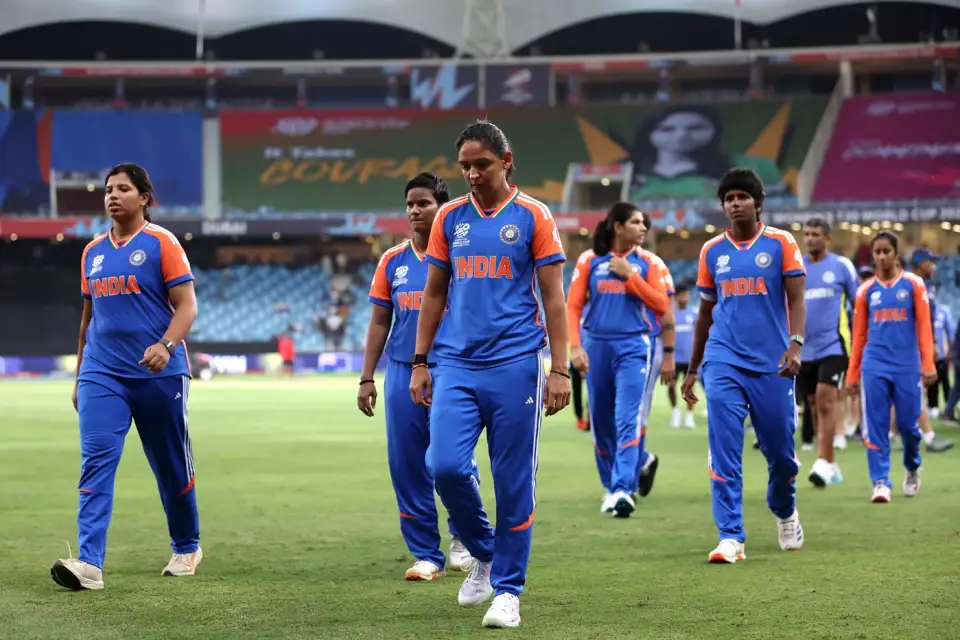

India’s journey in the Women’s T20 World Cup 2024 came to an unfortunate end when New Zealand emerged victorious by 54 runs over Pakistan in Dubai on Monday.
After Harmanpreet Kaur and the ladies lost to Australia on the last day, they hoped that Pakistan would pull off a miracle against the White Ferns to help them get into the knockouts. But in the end, courtesy of exceptional bowling performances from Eden Carson and Amelia Kerr, New Zealand easily cleared the obstacle, marching into the semifinals.
On the other hand, India looked massively half baked throughout the tournament, especially in their opening clash against New Zealand, which turned out to be a virtual knockout for the Women in Blue.
Apart from their win over Sri Lanka, the Amol Muzumdar-coached team was never at their best in the tournament. Following their initial defeat to the White Ferns, they struggled against Pakistan despite getting over the line. Eventually, they finished their journey came to an end after suffering a nine-run defeat against Australia.
Unfortunately, a team hailed as a ‘gifted unit’ had to crash out of the tournament from the group stage. Throughout the campaign, India never looked like a team that could challenge for the crown. Moments of madness in crunch situations, lack of planning and poor decision-making defined India’s World Cup journey in the United Arab Emirates. Here are the key takeaways from India’s forgettable campaign
No set number 3 for India
The Number 3 position in any batting order is important, more so in T20Is. The number 3 needs to be very flexible with their approach and bat according to the demands of the team. They are at the crease just after an early fall of a wicket or need to slog from the first ball after coming in on the slog overs. In this important position, India have used six different players in 2024. Only Pakistan have used more batters in that position in this period.

Amol Mazumdar said that captain Harmanpreet Kaur would take up the responsibility and bat at no.3. But even after that, it was not followed consistently. Even in the World Cup, the position was rotated between Jemimah Rodrigues and Harmanpreet. While the skipper came out at three against New Zealand and Sri Lanka, it was Jemimah, who was preferred in that position against Pakistan and Australia. This constant change in batting order meant that there were no set roles for the batters and hence they struggled to execute their plans.
Also, a lot was expected from Smriti Mandhana but the southpaw other than her fifty against Sri Lanka struggled massively. In fact, other than Harmanpreet no other Indian left a mark in the campaign with their willow.
Below average captaincy
Following India’s dismissal from the tournament, Harmanpreet Kaur’s captaincy is under scrutiny. While there’s no doubt that Harmanpreet is India’s best batter in the current setup, many feel her captaincy days are over. She has been leading the Indian team in T20Is since 2012 and she owns a decent record in this format. However, her record isn’t that great against stronger opposition.

Even in this World Cup, we saw several questionable decisions from her starting from a lack of planning in team selection to poor bowling changes, which has massive hampered India’s chances.
India’s bizarre selection choices also hampered their chances in this tournament. In a bid to have a sixth bowling option, India shortened their batting lineup whilst playing three pacers on conditions that are known to suit the slower bowlers.
Apart from that, Harmanpreet’s bowling changes were also questionable throughout the tournament. Despite Radha Yadav creating chances with her left-arm spin and Deepti Sharma getting breakthroughs, Harmanpreet turned to her pacers, Arundhati Reddy and Pooja Vastrakar. It was difficult to understand her thought process as the pitch was favouring the slower bowlers. Adding to that, her field placements were also flawed which continued to haunt the Indian team.
Lack of matches before the tournament
While other teams were coming to this T20 World Cup on the back of a few international matches, India headed to UAE after two training camps under the stewardship of Amol Muzumdar. He highlighted how India had two training camps with all the required facilities in Bengaluru.
He pointed out how the first camp was dedicated to fitness and fielding while the second camp focused on skill development. Mazumdar even thanked his support staff and the players and believes that the team was extremely well prepared for the tournament.
However, things were drastically different on the opening night for the Women in Blue. Indian bowlers struggled to settle in the slow UAE wickets. Everyone knew that India’s opening game against the White Ferns would be extremely crucial and they needed to put their best foot forward in that particular game.
But Indian bowlers missed their lengths and conceded 160 against New Zealand at a venue where runs haven’t come smoothly for most teams. Later, India’s collapse with the bat also proved that they were nowhere near their best at the start of the tournament.

All in all, India need serious introspection after their T20 World Cup 2024 campaign was cut short. They have given far better performances in this tournament earlier and this was simply a level below the rest. At 35, Harmanpreet Kaur’s captaincy days in T20Is are likely behind her. But rather than having a knee-jerk reaction, the management and the team need careful introspection and a fresh set of ideas to bounce back stronger than ever.


Leave a Reply