

Verily, there is a timeless joy in witnessing the fervor of our Senior Hockey Nationals. The very grand stage where India’s best players young and seasoned alike come forth to test their mettle.
From the dawn of our nation’s love for the sport, field hockey has been a beacon and drew forth heart and soul from every corner of our motherland India.
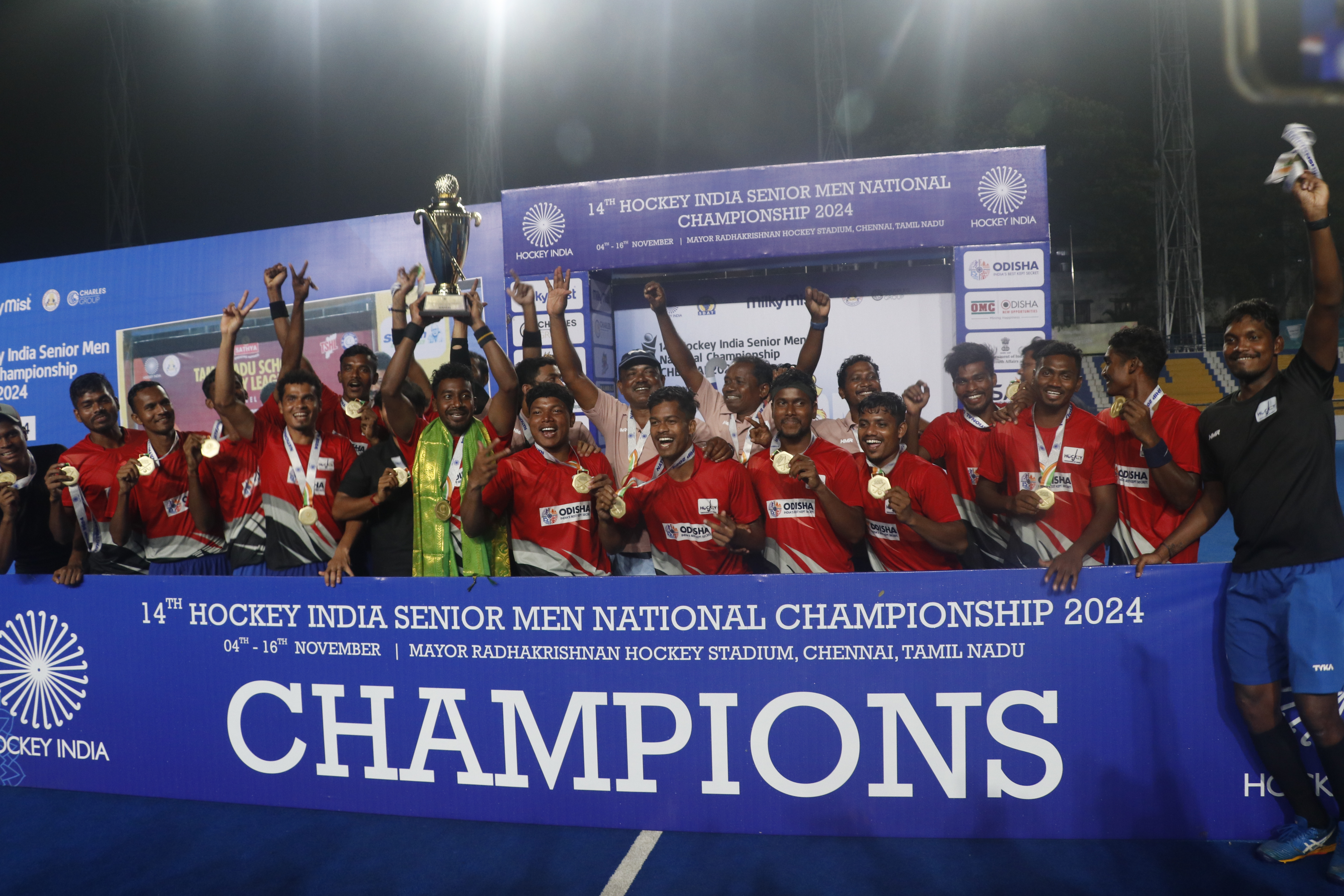
On 16th November, Odisha carved its name in the ‘Konark’ of Indian hockey history by clinching their first-ever Senior National Gold in the Men’s category. A monumental achievement for a state that gave rebirth to hockey in India with its relentless dedication and passion for the sport.
Meanwhile, Haryana secured the silver medal and continued their remarkable consistency at the Senior Nationals with back-to-back podium finishes.
A Senior National podium finish represents the pinnacle of domestic hockey excellence and deserves to be celebrated as a testament to the skill, grit, and determination of the players.
Read more: Rani Rampal: The Sovereign of Indian Hockey, A True Amazon of Our Age
This historic triumph for Odisha not only elevates the profile of hockey in the state but also inspires countless young athletes to dream big and work tirelessly toward their goals.
For Haryana, their silver is a reaffirmation of their standing as a powerhouse in Indian hockey, demonstrating their unwavering commitment to producing top-tier talent year after year.
So far so good. And yet, as one ponders the spectacle unfolding each year, it must be said that the format, in its current guise, falls somewhat short of nurturing the true breadth and diversity of Indian talent.
Could there, perchance, be a better way to bridge the chasm between disparate teams—a way that calls forth both fair play and regional pride?
Hockey Andhra Pradesh 0 – 17 Hockey Madhya Pradesh; Manipur Hockey 19 – 1 Hockey Bihar; Hockey Madhya Pradesh 29 – 0 Hockey Andaman and Nicobar; Hockey Maharashtra 30 – 0 Hockey Gujarat; Hockey Tamil Nadu 43 – 0 Hockey Andaman and Nicobar.
I dare say after watching the above games and commenting on them, a zonal format would serve our beloved game most gloriously, honoring both the legacy of old and the aspirations of a new generation.
Read More: Hockey India League: Ushering a New Era, Honoring Dilip Tirkey’s Vision
In this present manner of play, I personally feel, the tournament is a mixed bag with teams of varying strengths locked in matches where the chasm between skill levels becomes painfully evident.
Here, our young and fledgling players are, time and again, cast against formidable sides with more resources that resulting in what can only be called an unfortunate mismatch.
By contrast, a zonal format, one that holds each region’s mettle to the flame in its own right, could well ensure a truer test of skills and a more level playing field.
Would it not be more just for the less-heralded teams to first sharpen their edges in zonal rivalry and emerge victorious from their homelands before facing the giants of the game on the national stage?
Read More: The utility of the Lone Centre Back in Field Hockey
With such a system in place, the spectacle of hockey would rise to new heights, each zone offering champions that embody the spirit of their soil, the pride of their people.
In this, the tournament shall be as a hearth, stoking the flames of both competition and camaraderie, wherein young teams may hone their blades without the burden of facing unscalable heights from the outset.
A wise step towards equitable competition, you reckon?
It has been said that the mightiest oak once lay as a humble acorn upon the earth is awaiting the touch of sun and rain to rise in all its splendor. So, too, must we nurture our youngest hockey players and ensure they are not trodden underfoot by premature contests against established powers.
With a zonal structure, I personally feel, the game’s very roots shall be fortified; for in every region, the passion for hockey shall take on a life of its own and bolsters rivalries that are as much a matter of local pride as they are of national glory.
What do the experts say?
Country’s top hockey players should play the Hockey Nationals: Asian Games Silver Medalist Mir Ranjan Negi
This vision of revitalizing the sport aligns with the sentiments of Mir Ranjan Negi, the 1982 Delhi Asian Games silver medalist and former national coach, who passionately advocates for a renewed approach to elevate the status and appeal of India’s national hockey tournaments.

Speaking exclusively to Fieldvision he said,“I strongly feel that all All-India Hockey tournaments and national championships deserve proper respect and recognition,” Negi emphasizes. “Organizers put in tremendous effort to make these events a success, and it’s crucial that they receive the support they deserve.”
Negi believes that the participation of top players is essential to attract and retain public interest. “All of India’s top hockey players should be encouraged to participate in these competitions, just as the world’s best tennis players ensure they appear at the French Open, US Open, and Wimbledon. Without our star players, these tournaments risk becoming lackluster, drawing only die-hard fans instead of broader audiences. We need the crowd to feel the excitement that comes when the best are on the field.”
Negi also suggests that exhibition matches featuring women’s hockey players could add glamour and fresh enthusiasm to the tournaments. “Glamour and entertainment should be integral to any sports extravaganza, and hockey is no exception. By including high-energy exhibition games, we can enhance the appeal and showcase the diversity of talent in Indian hockey.”
To make these tournaments truly memorable, Negi insists that prominent figures in hockey be present at these events. “Players like Dhanraj Pillay, PR Sreejesh, Rupinder Pal, and even myself—we should be there, visible and engaged in the action. The presence of such well-known names not only inspires players but also draws fans and media attention, bringing the tournaments the prestige they deserve.”
Imagine, if you will, the stirring sight of players clad in the colors of their regions, vying in their homeland for a chance to represent not merely themselves but the very essence of their soil.
Therein lies a vision to gladden the heart of any lover of hockey. It is in these very regional contests that players are tested, that young talent may grow in strength, and that the populace—nay, the very soul of our country—may rally behind them
Multi-tier system in the Zonal Format will elevate the standard of Indian Hockey : Dr Saju Joseph
This concept aligns seamlessly with the structural reforms proposed by Dr. Saju Joseph, a renowned sports scientist and former Team India physical fitness trainer and coach. Advocating for a ladder-based system within the zonal format, Dr. Joseph sees it as a game-changer for the Senior Nationals, one that can foster not just competitive spirit but also elevate the technical and strategic caliber of players and coaches alike.

According to him, the format should be structured in such a way that teams are ranked based on their previous performances in the Nationals, creating six distinct ladders from A to Z. Each team would compete within their respective ladder, with the opportunity to progress.
Winning teams in each stage would climb to a higher ladder, while the lowest-ranked team in the top ladder would be relegated. This dynamic would inject excitement and a sense of progression, ensuring that every match has high stakes.
Dr. Joseph also suggests that the league format within each ladder be played in different cities, with the host city rotating between the six teams.
This approach, he believes, would not only add a competitive edge to the tournament but also help in spreading the game to different regions, giving fans across India a chance to witness the thrilling action of the Senior Nationals firsthand.
According to Dr. Joseph, the zonal format provides a unique opportunity not only to showcase talent but also to elevate the technical knowledge and strategic acumen of both players and coaches. “To truly enhance the performance and coaching standards, educational sessions should be organized simultaneously during the competition, especially on off days,” he suggests. “This will give players a deeper understanding of technical aspects and strategies, helping them to evolve as more complete athletes.”
Dr. Joseph further advocates for the involvement of top-tier coaches to lead these sessions. “We need to invite experienced coaches to conduct classes on systems of play, set plays, and specific drills. These educators should be directly attached to the ladder system within the zonal format, allowing them to groom both players and coaches in real time.”
He believes this approach could significantly raise the standard of hockey across all levels. “With the right guidance and continuous education, we can bring about a tangible improvement in the way the game is played and coached. The zonal format, coupled with such initiatives, has the potential to revolutionize Indian hockey,” Dr. Joseph concludes.
Let it be known that a victory hard-earned is a victory sweeter, and the journey towards national competition should be paved with moments of genuine triumph. For many an emerging player, the opportunity to stand atop a zonal podium would be a treasure, a stepping stone to greater glories.
Such a structure lends itself not only to individual pride but also to a collective spirit that binds the hearts of players and fans alike. To the victor in each region, there would be honor and respect, a stamp of approval by one’s very homeland before stepping into the broader arena.
In truth, is there aught more stirring than the scene of a team bearing the spirit of their state or zone, ascending to compete on a stage worthy of their valor? Such a format breathes life into each step, each small triumph a feather in the cap that serves to steady the resolve of the players and elevate the game itself.
Two-Tier Format worked best for all: Mukul Pandey
It is this pursuit of balanced competition and meaningful progression that Mukul Pandey, former player and national coach, reflects upon when recalling Hockey India’s earlier attempt to address lopsided matches in the Senior Nationals. “I remember HI introduced a two-tier system some years back,” Pandey recalls speaking exclusively to Fieldvision.
“Teams were split into two pools to create a more balanced competition, with the last two teams from Pool A relegated to Pool B, and the top two from Pool B promoted to Pool A,” he added.
He points out that this structure even allowed the tournament to be held at different venues or sometimes at the same venue on separate dates, maximizing flexibility.
Yet, despite its success, the system was suddenly discontinued, reverting back to a single-tier national championship. “I’m not fully aware of the reasons behind the change,” he admits, “but from my experience, the two-tier format worked best for all.”
Permit me once, with your kindness, to venture into the pocketest corners of our sport and system here – the grassroots. The beauty of hockey lies not only in the dazzle of stickwork or the thrill of the final shot but also in the quiet persistence of those who toil in obscurity.
To them, the zonal format offers both refuge and reward, a means by which they may grow strong without fear of being overshadowed by giants too soon. In truth, the path to glory should be as a ladder, rung by rung, whereby the finest teams from every corner of the nation ascend to the nationals by merit alone, weathered by worthy contests.
Need to revamp domestic Hockey structure: Roshanjit Singh
It is a sentiment echoed by Roshanjit Singh, a seasoned hockey player who represented Andhra Pradesh Police for six years. Drawing from his extensive experience within the Indian hockey fraternity, Mr. Singh highlights the pressing need for a revamped domestic structure. “A two-tier national championship,” he suggests, “would not only foster competitiveness but also offer weaker teams a real chance to hone their skills and rise steadily.
”The current system is not conducive to promoting competitiveness and growth,” Singh opined. “A two-tier system would allow the top 12 teams in the country to compete in the premier division, while the weaker teams would get an opportunity to fight for promotion to the top tier.”
Singh also suggested that the top four teams from the second tier should be promoted to the premier division, making it a 16-team tournament. “This would increase competition and provide more opportunities for teams to participate at the national level,” he explained while speaking exclusively with Fieldvision.
Shyamal Bhattacharjee, infamous hockey historian and author of From Dhyan to Dhan: Indian Hockey Sudden Death or Extra Time – A Parable of Indian Hockey Through 94 Years and 8 Gold Medals, advocates for a zonal structure to rejuvenate the Senior Nationals.
The best way forward is to divide the country in Five Zones: Shyamal Bhattacharjee
“The best way forward would be to divide the country into five zones—East, West, South, North, and Central,” Bhattacharjee suggests in his exclusive chat with Fieldvision. “Each zone would then compete internally, with the top two teams from each zone advancing to the main national tournament.”
This structure, Bhattacharjee believes, would bring a level of focus and competition that the current system lacks. “With ten teams making it to the national stage, they could then be split into two groups. From there, the top teams would advance to the semifinals and finals, creating a more merit-based and thrilling progression toward the championship.”
Bhattacharjee emphasizes that this approach would not only elevate the competition but also prevent the one-sided games that have sometimes marred the tournament in the past.
“This setup eliminates the possibility of one team defeating another by scores like 43-0, which, frankly, diminishes the spirit of competition. A zonal format would ensure that only the best move forward, enhancing the quality and integrity of the championship,” he concludes.
Long story very short, may this call not fall upon deaf ears. Let us, for the love of the game, for the honor of those who laid the foundation of hockey in this land, and for the betterment of all who seek to carry forward the legacy, consider this proposal with an open heart.
By instituting a zonal format, we might well ignite a new era in Indian hockey, one that respects every player’s journey, honors every state’s pride, and binds the entire nation in the shared joy of witnessing our best take the field.
Follow Fieldvision on Youtube ,Twitter , Facebook Instagram and Whatsapp Channel for more updates.


Leave a Reply