
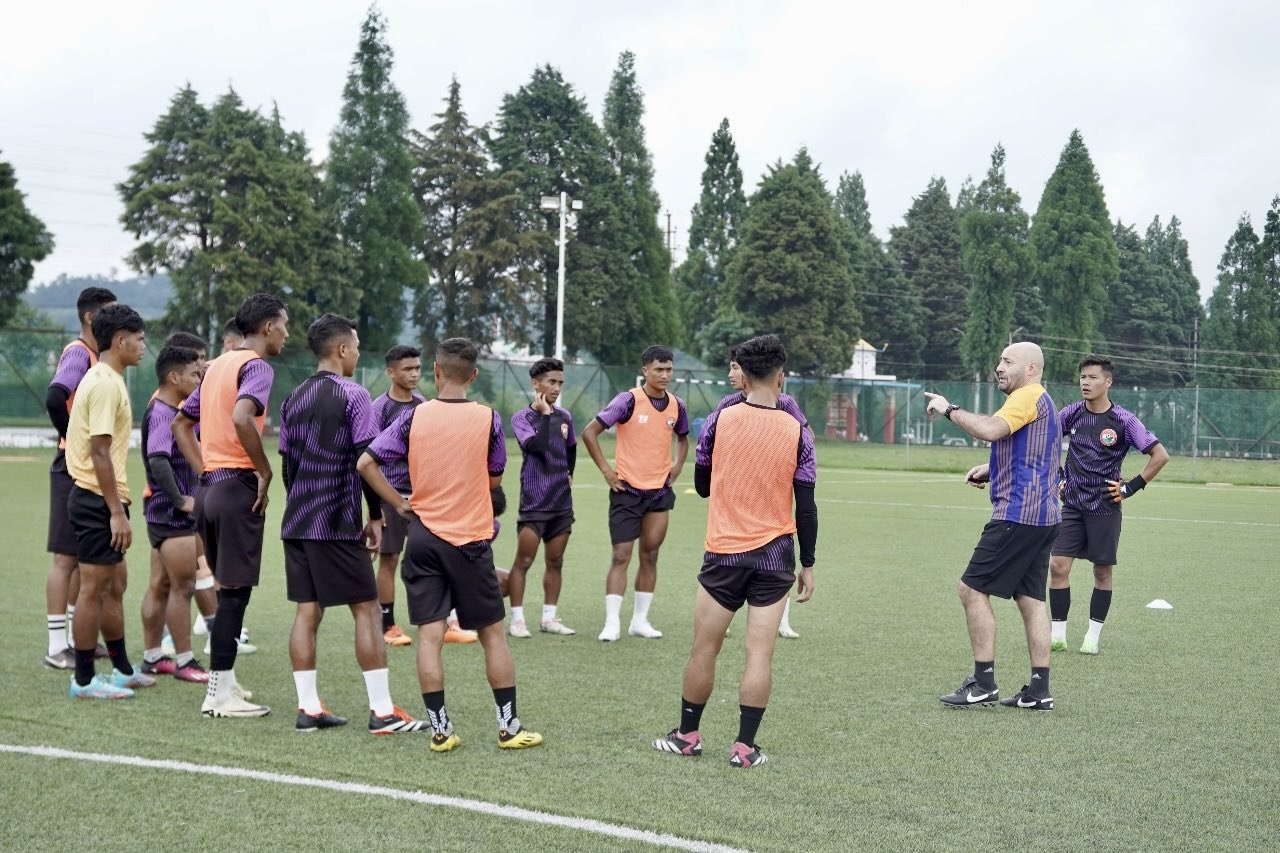

For those unfamiliar with Jose Hevia’s background, his journey in Indian football has been nothing short of remarkable. Starting with his role at Arsenal Academy, he later contributed to the FC Pune City academy before taking the reins as head coach at Minerva Punjab, Mohammedan Sporting Club ,Shillong Lajong .
Hevia’s contributions have earned him respect as one of the most influential foreign coaches in Indian football’s grassroots and professional circuits.
In the first part of our exclusive interview, José Hevia opened up about his decision to return to Shillong Lajong despite his previous assignment in Colombia. He shared insights on the conversation with the club’s management, the changes at Lajong since his last stint, and the unique role the club plays in developing players in India. Hevia emphasized the deep connection between the club and its homegrown players, which he believes is a cornerstone of Lajong’s identity and success.
Read the first part of the interview here: Coach José Hevia’s return to Shillong Lajong FC: A Tale of Passion, Progress, and Purpose
Now, in this second part of the interview, we delve deeper into Hevia’s journey and thoughts on Indian football. He reflects on his experiences in India since 2014, the challenges of starting his coaching journey here, and his perspective on the integration of I-League players into the national team. He also sheds light on the differences he encountered while coaching various teams across the country.
Excerpts from the conversation are below:
Thoughts on Shillong Lajong’s delayed start to the season
José Hevia candidly expressed his concerns about the delayed start to the season, emphasizing its challenges for both players and coaching staff. “Obviously, it’s not good. It’s not good at all,” Hevia remarked, reflecting on the adjustments his team had to make to maintain momentum.
To adapt to the disruption, Lajong implemented an innovative approach, treating the post-Durand Cup period as a second pre-season. “After the Durand Cup, we gave the team 10 days of rest and then started a new pre-season. We prepared everything as if it were a six-week regular pre-season,” he explained. Despite logistical challenges, the team aimed to maintain competitive sharpness by organizing matches against teams from Shillong and Meghalaya.

“The idea was to ensure the players didn’t lose the habit of facing opponents. Playing only among ourselves or against the reserve team isn’t ideal. While we couldn’t fully replicate the intensity of a league or a tournament like the Durand Cup, we did our best to keep the players’ minds focused and concentrated,” Hevia added.
Despite the hurdles, he believes the team is well-prepared. “The time was longer than we wanted, but we tried to make the most of it. The players are in a good moment and a good situation,” Hevia concluded, highlighting the team’s positive resilience and adaptability.
On his experience in India Since 2014
Reflecting on his decade-long association with Indian football, José Hevia expressed mixed feelings about the progress made since he first arrived in 2014. While acknowledging certain advancements, he emphasized that the development of youth football in India has not met his expectations.
“When I came here in 2014, I expected much more improvement with the impact of the Indian Super League (ISL) and the support of the federation for the I-League. I thought both competitions would drive significant growth in youth development across India, but that hasn’t happened to the extent I anticipated,” Hevia shared.
Drawing comparisons with Colombia, Hevia highlighted the need for full-year youth competitions. “In Colombia, the system was similar to India’s, with short tournaments of two or three months. However, in the last five years, they’ve implemented full-year competitions where players get to play matches every weekend. This consistent structure has been crucial for player development. India needs something similar,” he noted.
Hevia also pointed out the importance of better conditions, champions, and leadership in nurturing young talent. Echoing the sentiment recently shared by national team coach Manolo Marquez, Hevia stated, “India needs a proper long-term championship every year to truly develop its youth football system.”
Read Our Exclusive with the NEUFC head coach: From Morocco to NorthEast: Coach Juan Pedro Benali on Transforming Northeast United FC and Unleashing India’s Football Potential
I-League players in the National team
José Hevia firmly believes that the I-League remains a vital pool for nurturing talent capable of representing the Indian national football team. Reflecting on his past experiences, he recalled a moment of foresight with former player Mahesh Naorem, now a prominent figure in Indian football.
“When I was coaching Mahesh, I told everyone that he would be a future Indian national football player. People thought I was crazy. But look at him now,” Hevia shared with a sense of pride. His ability to identify and nurture talent has been a recurring theme throughout his coaching career.
Hevia also spoke about the current crop of players at Shillong Lajong, emphasizing their immense potential. “Right now, we have some unbelievable talent in our squad. If they continue developing at this level, I’m confident they’ll make it to the national team. Hopefully, this league season will be their stepping stone,” he said.
He praised India’s head coach, Manolo Marquez, for his comprehensive approach to scouting. “Manolo is very clever. If he sees I-League players performing at the required level, I’m certain he’ll give them a chance with the national team,” Hevia added, highlighting the growing recognition of the I-League as a platform for future stars.
Difference of coaching different teams
José Hevia shared his insights on the varied coaching experiences at different clubs, emphasizing the significant differences in structure and management. Reflecting on his time at FC Pune City, Hevia recalled the challenges of working with a new club. “FC Pune City was a new club when I joined, and the structure was very weak. Everything was in its early stages, and decisions were often made at the last minute. There wasn’t much time to prepare or set clear plans,” Hevia explained, highlighting the growing pains of a fledgling club.
His stint at Mohammedan SC, however, stood out for a more personal reason. “Mohammedan had a very special management situation. There were two big families in the club, each wanting control, and at the time, it felt like a big war between them. I was caught in the middle, and it was a very difficult experience,” Hevia shared, recounting the internal conflicts that made managing the club even more challenging.
In contrast, his time at Minerva Punjab was short but marked by the club’s growth phase. “Minerva was in a very transitional period. I was only there for five months, and while the club was growing, the period was too brief to make a major impact,” Hevia noted. Similarly, he described his experience at Barraco Soccer Academy as one where the project was just starting, making it another challenge of building from the ground up.
However, his time at Shillong Lajong provided a different dynamic. “Shillong Lajong was already established, competing for 15 years by the time I arrived. Everything was clear about how the club was managed, and there was a stronger foundation,” Hevia observed, contrasting the stability at Lajong with the uncertainty he had faced at his previous clubs.
Follow Fieldvision on Youtube ,Twitter , Facebook Instagram and Whatsapp Channel for more updates.


Leave a Reply