

The 2024 Singapore World Chess Championship much like the thrilling trajectory of international hockey is a battlefield where legends are born, strategies are immortalized, and rivalries carve indelible marks on history.
Since its inaugural match in 1886, this grand stage has been a relentless arena for intellectual combat akin to the pulsating center of a hockey pitch where every pass, every flick, and every tackle has its place in the greater narrative.
From Wilhelm Steinitz’s first strike in 1886 against Johannes Zukertort to the relentless attacks and defenses of players like Emanuel Lasker and Jose Raul Capablanca, the early years of the championship mirrored the resilience of early hockey’s pioneers. Alexander Alekhine’s gritty comeback against Max Euwe was akin to a penalty corner conversion in extra time, proving that champions often rise from the ashes of defeat.
A little walk into the history, the Soviet dominance of chess embodied by Mikhail Botvinnik’s era was reminiscent of hockey dynasties and marked by players like GM Tigran Petrosian, who fortified their positions like impervious defenders. Yet, it was Bobby Fischer’s stunning victory in the “Match of the Century” in 1972 that resembled a forward breaking a defense to score against the run of play, breaking the Soviet stranglehold on the title.
But the modern era brought new tactics and controversies with Garry Kasparov’s split from FIDE echoing the structural revolutions in hockey leagues worldwide. The reunification of the championship in 2006 under FIDE’s aegis with players like Viswanathan Anand and Magnus Carlsen bringing flair and dominance mirrors the evolution of hockey into a faster, more dynamic game.
Indeed, Carlsen’s abdication of the title in 2023 was akin to a star player stepping away at the peak of his powers and leaves the field wide open for new challengers. In this context, the clash between Gukesh and Ding Liren not only signifies a new chapter but also evokes the essence of hockey—a game of resilience, tactics, and unyielding spirit. The passage of baton at the 2024 World Chess Championship became a reminiscent of an intense hockey match, where every move feels like a deft pass, every tactic a power play, and every blunder an unforced error.
India’s Gukesh Dommaraju and China’s Ding Liren have locked horns in a 14-game series that mirrored the grit and grandeur of a championship hockey final as they vied for the ultimate crown in chess.
At this moment, one cannot help but draw parallels between Gukesh’s incredible journey to the top of the chess world and Germany’s unforgettable campaign in the 2023 Hockey World Cup in Bhubaneswar. Germany staged miraculous comebacks in the quarters, semis, and finals, eventually defeating Belgium in one of the most dramatic World Cup victories in hockey history. Gukesh’s journey reflects a similar trajectory—a story of comebacks, grit, and an unshakable will to triumph.
Each player has showcased moments of brilliance that of a hockey forward weaving past defenders, only to be denied by an equally astute goalkeeper. The games have unfolded like a chessboard version of the midfield battles of hockey—fluid, tactical, and unrelenting.
If you ask me, Ding Liren’s aggressive start in Game 1 was much like a hockey team converting an early penalty corner, catching Gukesh off guard. But the Indian prodigy, channeling the spirit of a composed midfielder, rallied back with a scintillating counterattack in Game 3, equalizing with flair and determination.
Each subsequent game mirrored the tactical brilliance of hockey, with players rotating formations—knights becoming midfield generals, bishops holding the flanks, and pawns stepping into defensive roles, making the chessboard feel like a packed D-zone in hockey.
From the very first game, Ding Liren brought his A-game to the center and delivered a scintillating blow akin to a drag-flick conversion that caught Gukesh off guard. But the Indian prodigy, with the precision of a seasoned midfielder, rallied back in Game 3, leveling the score with a counterattack that left his opponent scrambling for cover.
The following games became a tactical minefield as both players employed their pieces like a hockey coach rotates formations to keep the opposition guessing. Knights became the playmakers, bishops controlled the flanks, and pawns advanced like determined defenders, ensuring the center of the board resembled a packed D-zone.
The tournament has seen no shortage of stalemates with each game ending in a draw serving as the chess equivalent of a midfield tug-of-war, where both players refused to yield an inch. Game 9, in particular, was an endgame masterclass, with both players maneuvering like a full press in hockey—trapping and prodding, testing each other’s mettle until the final seconds.
Ding’s calm demeanor and clinical approach have been similar to a hockey goalkeeper marshaling his defense. Meanwhile, Gukesh’s creative forays, laced with audacious sacrifices, have brought to mind a forward’s flair for improvisation, trying to find a gap in the defensive wall.
Games 11 to 14 were the tournament’s crescendos as each showcased a penalty corner in its intensity. In Game 11, Gukesh orchestrated a brilliant victory much like a perfectly executed penalty corner set piece, leveling the overall score and reigniting Indian hopes. But Ding Liren, showing the resilience of a hockey veteran, returned in Game 12 to snatch a win with surgical precision.
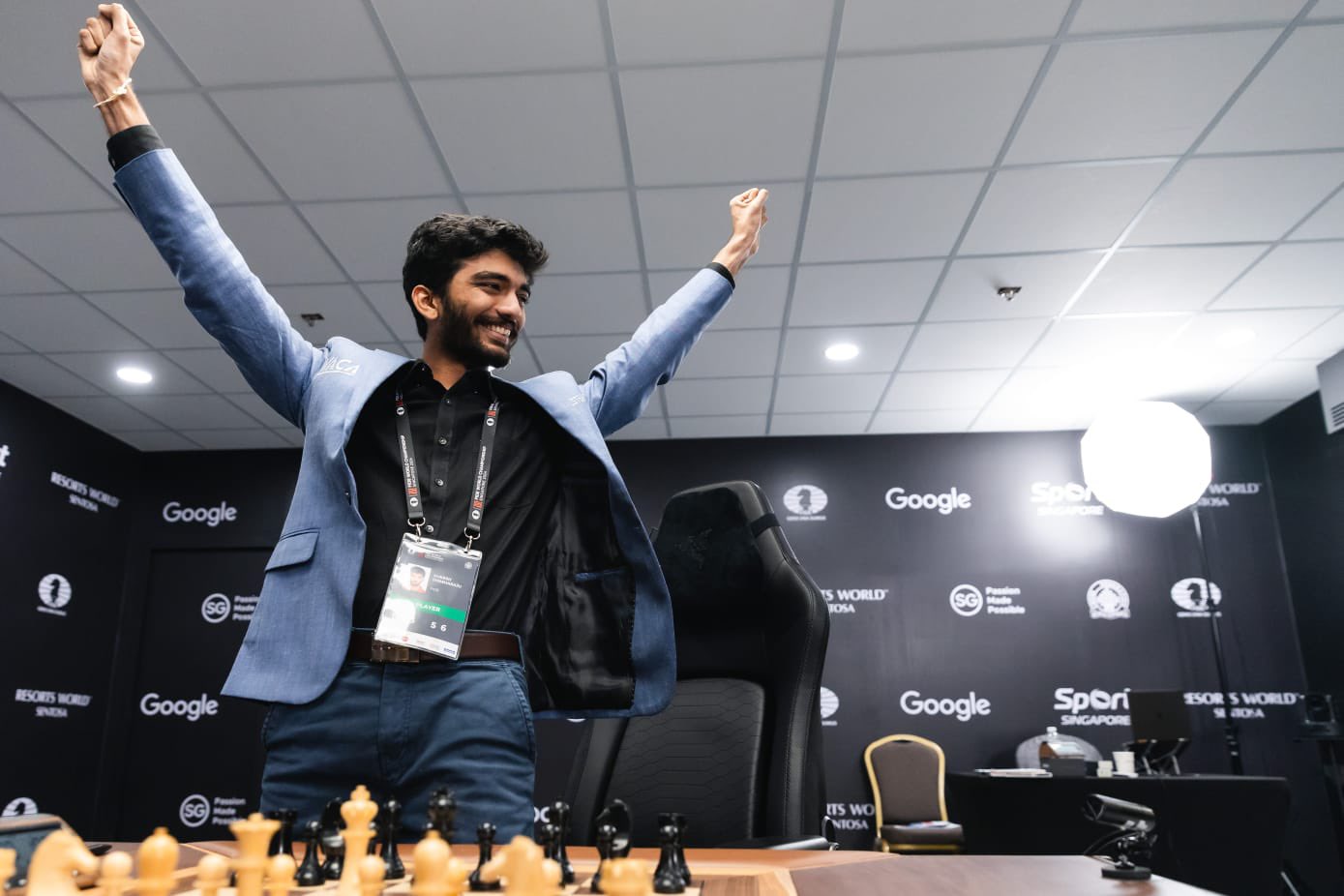
Much like the penalty shootouts that sealed Germany’s World Cup fate in Bhubaneswar, the final stages of the World Chess Championship were poised on a knife’s edge. The weight of expectation, the hope of a nation, and the hunger for glory rested heavily on Gukesh’s young shoulders. And in a dramatic 14th match, he delivered the decisive blow. A victory as electrifying as Florian Fuchs’ match-winning strike in the dying moments of Germany’s World Cup final.
The contest’s final moments were as thrilling as the dying minutes of Q4 of a hockey match where adrenaline surges and every move carries the weight of destiny. Gukesh triumphed and ensured the chess crown would return to India—a nation pulsating with excitement for its prodigy.
Long story last, very similar to their historical ties and border disputes, India and China’s sporting clashes are rich with narratives of competition and camaraderie. On the chessboard, Gukesh emerged as the young forward who represented India’s burgeoning chess scene, while Ding Liren, the seasoned captain, sought to defend his legacy. In the end, Gukesh’s inventive play overwhelmed Ding’s stoic defense and marked the dawn of a new era.
Follow Fieldvision on Youtube ,Twitter , Facebook Instagram and Whatsapp Channel for more updates.




Leave a Reply