
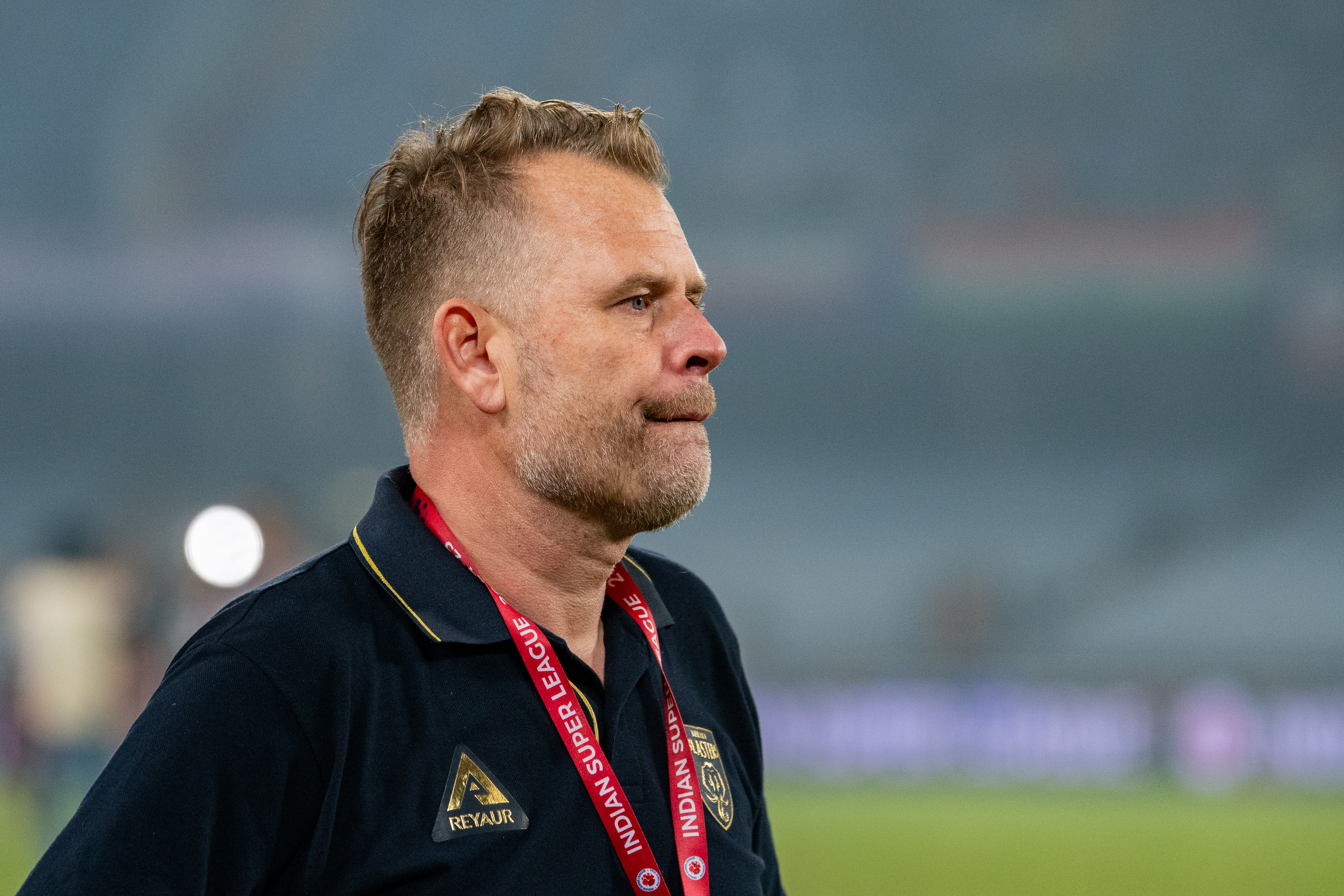

Kerala Blasters’ performance under Swedish coach Mikael Stahre has left both fans and football critics far from impressed. A team that had consistently secured a spot in the top six over the past three seasons now finds itself languishing in 10th place. With just three wins, two draws, and seven losses in their first 12 matches, the writing was on the wall for Stahre, who was shown the door midseason by the Tuskers.

As per @totalf0otball‘s data model, the Blasters have already hit their margin of error—20 points—effectively ruling them out of contention for the league shield. The hunt for a new leader is underway, but for now, reserve coach Tomasz Tchorz and assistant coach TG Purushuthoman are steering the ship.
The big question remains: can Kerala Blasters rise from the ashes and make a turnaround, or is this season destined to be another cautionary tale in the history of Tuskers?
What’s the tweak?
Dissecting the root causes of Kerala Blasters’ struggles, the issues span a wide spectrum—from individual mistakes and coaching errors to the failure in executing strategies and an over-reliance on a handful of predictable ideas. To truly understand where things have gone wrong, let’s break it down, starting with the offensive dynamics of the team.
Chaaaarrrgge..!
Jesus – the Saviour!
One of the most captivating aspects of Mikael Stahre’s tenure at Kerala Blasters was undoubtedly his attacking front, spearheaded by Spaniard Jesús Jiménez. Fans had their fair share of anxiety following the departure of the club’s all-time top scorer and ISL 2023-24 Golden Boot winner, Dimi Diamantakos, who moved to East Bengal during the summer transfer window. However, the dismay was short-lived.

Baranidharan M / Focus Sports / FDSL
The management filled the void by bringing in Jesús Jiménez—a move met with skepticism given his inconsistent form prior to joining the Blasters. But Jiménez silenced the critics with a stellar performance, racking up 9 goals and 1 assist in just 12 league matches. A complete team player, Jiménez showcased exceptional positioning and versatility. Whether dropping deep to collect the ball or making incisive runs, he proved to be a crucial asset in attack. His left-wing bias added another layer of dynamism to the team’s offensive setup.
While Jesús Jiménez’s tactical contributions could certainly be analyzed in greater detail, it’s worth noting that his performances offered no visible shortcomings that would have directly contributed to Mikael Stahre’s dismissal. Given the focus here is on identifying the factors behind the coach’s exit, further exploration of Jiménez’s role can be set aside for now.

Cross to Noah and pray!?
Noah Sadaoui, with his sprints and footwork, needs no introduction to Indian football fans. The Moroccan winger picked up right where he left off with the Gaurs last season, tallying 4 goals and 4 assists in 10 appearances under Mikael Stahre. His contributions were pivotal during the initial stages of the campaign. But was everything smooth sailing for Stahre’s Noah? Was he truly consistent? While his overall stats might suggest a resounding “yes,” a closer look at the tactical nuances tells a different story.
Of his eight goal contributions (4G+4A), five (4G+1A) came in the first five matches. This striking imbalance raises questions about his long-term impact. Let’s put the stats aside for a moment and dive deeper into Noah’s movements, his tactical execution, and how he was countered.

Mikael Stahre often relied on Sadaoui to initiate attacks, and while this approach bore fruit in the early matches, it soon became predictable. Opponents studied his tendencies, and Noah found himself tactically neutralized as the league progressed. His former coach, Manolo Marquez, provided a masterclass in shutting him down by deploying Boris Singh effectively.
Noah Sadaoui often thrives in situations where he has both space and time to maneuver. His movements are often reactionary—he waits for the opponent to make a move and then beats them with his pace or skill. However, this reliance on freedom became his Achilles’ heel. Once opponents curtailed his space, his effectiveness dwindled, and his confidence visibly took a hit.
In simpler terms, Noah is a player who flourishes when allowed freedom, but when that freedom is restricted, his performance dips. This tactical limitation became a significant challenge for Stahre, who struggled to adapt and find alternative ways to unlock Noah’s potential in tightly marked situations.
When up against players who can match his pace and defend with patience and discipline, Noah often struggles. These situations typically force him into committing mistakes or retreating to pass the ball back, disrupting the attacking flow.
This tactical limitation has a ripple effect. Once Noah is effectively “locked,” the supply chain to his teammates is cut off, significantly reducing the team’s attacking options. This not only limits the effectiveness of the frontline but also places additional pressure on other attacking outlets, exposing a glaring vulnerability in the team’s overall strategy.
Luna not Luna-ing?
Under Ivan Vukomanović, the Kerala Blasters’ strategy consistently revolved around their charismatic club captain, Adrián Luna, right from the first match. Over three seasons, Luna’s influence was undeniable—he was the team’s heartbeat, dictating play with his trademark “free role.” This role granted him complete freedom to roam the pitch, orchestrate the game’s rhythm, and link the midfield with the attack seamlessly.

Photos : Shibu Preman / Focus Sports / FSDL
However, under Mikael Stahre, this dynamic was notably absent. Luna, once the centerpiece of the team’s system, was confined to a more rigid and specific role. This tactical shift had a dual impact—it stifled Luna’s natural creativity and significantly hampered the team’s overall performance.
The effects of this change were most evident in the home game against Mohammedans. Following Stahre’s dismissal and the appointment of Tomasz Tchorz as interim coach, the team’s approach shifted back to its Luna-centric system. The difference was immediate—the game’s rhythm returned to the familiar pattern of being dictated by Luna rather than relying on a Noah-centric strategy.
Inexistent right wing?
One of the most glaring issues for Mikael Stahre was the team’s virtually non-existent right wing—a problem that can be traced back to Ivan Vukomanović’s tenure following Adrián Luna’s injury. The team often had to rely on players whose performances epitomized inconsistency, leaving the right flank as a persistent weak link in their tactical setup.
The situation worsened with the injury of young prodigy Aimen, further depleting an already fragile roster of wingers. The team seemed to be running out of options, and the lack of a dependable presence on the right wing became a major handicap in their attacking strategy.
Relief finally arrived with the introduction of U-17 sensation Korou Singh, who brought energy and promise to the role. However, by the time Korou began making an impact, the damage was already done—it was curtains down for Mikael Stahre’s stint with Kerala Blasters.
JLN and player combinations
Before the season kicked off, fans were eagerly anticipating the resurgence of a new attacking trio, hoping for a repeat of the famous “LAD” combination from 2021. However, reality didn’t quite match the expectations. The trio of Jesús Jiménez, Noah Sadaoui, and Adrián Luna struggled to find a fluid understanding, failing to develop the chemistry that fans had hoped for.
One of the key reasons behind this disconnect was the role change of Luna, which shifted the game’s anchor from him to Noah. While this tactical switch could be justified, the Moroccan winger was ultimately seen confined to his natural position on the left wing. Fans who expected constant role fluidity between the three were left disappointed as the players remained largely restricted to their designated positions. This rigidity in roles led to a reduction in the overall contributions of the trio.
Under Ivan Vukomanović, the team’s passing game was a thing of beauty. Quick one-twos and fluid combinations were a hallmark of the Blasters’ play. Who could forget Luna’s spectacular one-two pass against Jamshedpur that sent the Kaloor crowd into raptures? With Jesús joining the ranks, fans expected even more of these sequences, but they never materialized under Stahre’s tenure.
In fact, it wasn’t just the JLN—across every facet of the game, Stahre struggled to establish proper combinations between the players. The constant experimentation failed to yield the expected results. One of the most glaring issues was the lack of consistency in the defensive setup.
Stahre never managed to establish a solid central defensive pairing or a reliable pivot like Ivan had done. Different combinations were tried, but none of them delivered the necessary stability or fluidity.
Is that a midfield?
The core of Kerala Blasters’ midfield remained largely unchanged from Ivan Vukomanović’s era, with the pivots once again expected to lead and control the tempo of the game. But was it as successful under Mikael Stahre? Unfortunately, the answer is disappointing. Both Ivan and Stahre relied on their pivots to dictate the rhythm of the match, deciding whether to progress or hold the ball based on the situation.
However, Stahre struggled to find the right pivot who could effectively control the flow of the game.

Photos : Shibu Preman / Focus Sports / FSDL
At times, one of the pivots was even tasked with taking on attacking roles, (this could be further understood through Vibin’s role shift from Ivan’s tactics to Stahre’s). Despite this tactical change, it rarely produced positive results. Adding to the problem were individual errors from certain players, which further compounded the situation.
Another glaring issue was the departure of Jeakson Singh, a player whose absence went unaddressed. While Freddy did perform admirably—arguably underrated—he alone couldn’t fill the void. The team had individuals with potential, but Stahre failed to weave them together into a cohesive unit. As Pele once wisely said, “Football is a team game. Success depends on your whole team being a single unit.” Unfortunately, that unity was sorely missing under Stahre’s leadership.
Where is defence?
The most persistent issue under Mikael Stahre’s tenure at Kerala Blasters was undoubtedly the defense. The problems within the team’s defensive structure were multifaceted, ranging from the absence of a commanding leader to costly individual errors. However, Stahre also played a role in this defensive frailty.
“Attack wins you games, but defense wins you titles” – Sir Alex Feguson
Highline and Stahre
Teams that attempt to play a high line often aims to create an offside trap, pushing opposing players into an offside position. A recent example of this was seen in the last El Clasico, where Real Madrid were frequently caught offside. However, executing this successfully requires discipline, effective communication among players, and sharp defensive awareness. When all these elements align, the result is a well-organized defensive unit that dictates the terms of engagement for the opposition’s attacking players.
Unfortunately, for Kerala Blasters, these aspects were never fully realized. Stahre’s attacking approach, which was often direct, created chaos at both ends of the pitch. Many of the attacks that were thwarted by the opposition quickly turned into counter-attacks, and the Blasters’ defense appeared unprepared and disorganized in responding to these threats.
However, the defensive unit cannot be blamed alone. Teams that play a high press and adopt an all-out attacking approach must also be able to counter the opposition’s movements in their own half. Often, movements that seem relatively harmless can quickly be transformed into attacking sequences by the opponents.
While Stahre consistently emphasized attack with Kerala Blasters, he failed to integrate defensive responsibilities into his tactical setup, unlike Ivan. For example, players like Noah, who were primarily focused on offensive duties, should have been given defensive responsibilities. Alternatively, a separate tactical plan should have been put in place to address this issue and ensure better balance across the team.
Absence of a leader
The absence of a leader like Marko Leskovic left a significant void in the defensive setup, with players frequently seen higher up the field, disorganized and lacking discipline. Compounding this issue, Stahre struggled to establish a reliable center-back pairing for his team. This indecisiveness not only sowed confusion among the center-backs themselves but also disrupted the cohesion of the entire defensive unit. Players were assigned varying roles in each match, further escalating the chaos and undermining their confidence and effectiveness.
Fullbacks
Among the defensive unit, Naocha emerged as the standout performer, transforming himself into one of the best left-backs in the league. Once criticized for his lack of offensive contributions, he turned the left flank into a livewire with his dynamic play this season.

Photos : Baranidharan M / Focus Sports / FSDL
In stark contrast, his counterpart on the right flank, Sandeep, struggled significantly. His attacking sequences lacked purpose, and his defensive performances also saw a noticeable decline. Although Hormi and Pritam were brought in as replacements, the situation on the right flank remained unchanged, highlighting a persistent vulnerability in that area.
Goalkeeping or Goalletting?
One of the major setbacks for the Tuskers this season was the noticeable dip in form among their goalkeepers. After a stellar debut season where he broke several records, Sachin Suresh returned to the field with high expectations, entrusted once again to guard the post. However, post-injury, Sachin’s performance has not been the same. Once celebrated not only for his exceptional goalkeeping skills but also for his precise offensive distributions, Sachin saw a significant decline in both aspects this season, leaving a void in the Tuskers’ defensive stability.

Not only did Sachin’s distributions and movements falter, but his confidence also appeared to have taken a significant hit. This was evident in one of the clips above (referring to Noah’s defensive anticipation), where his poor judgment allowed a preventable goal to slip through.
As a young goalkeeper returning from a shoulder injury—a critical body part for their role—such struggles were somewhat expected. Keeping this in mind, the Blasters should have prioritized signing a seasoned, experienced goalkeeper to stabilize the position. Instead, they opted for an even younger Som Kumar as their second-choice keeper, a decision that further highlighted their lack of depth in this vital area.
Comparing Mikael with Ivan
Now to the question that lingers in the minds of fans: who was better, Ivan or Stahre? What gives Ivan the edge is his ability to manage players effectively.
Ivan provided his players with freedom on the field while ensuring the team remained compact and disciplined. Across his three seasons in India, Ivan consistently stuck to the 4-4-2 formation in nearly every match. While his setup was simple, it was effective, consistently delivering results—barring the phase when key players were sidelined due to injury.
In contrast, Stahre experimented with various formations and combinations, but none of them translated into success on the field. He struggled to identify a reliable starting XI and failed to instill the unity and cohesion needed for a winning side.

Another factor that highlighted Ivan’s superiority was his utilization of home advantage. Under Ivan, the home ground became a fortress. On the other hand, despite thousands of fans flocking to the Kaloor Stadium to support the team, Stahre managed just one win in six home appearances—a dismal record that underscored his shortcomings.
When Stahre was appointed Head Coach, his primary mission was to build upon the foundation Ivan had constructed, refining and elevating it further. Both their profiles and approaches suggested a continuity of ideas. Perhaps even the management anticipated this progression, but somewhere along the way, the pieces never fell into place.
The immediate priority for whoever replaces Stahre is clear: not to build the team from where Stahre left off, but to rebuild it from where Ivan left—a return to a proven blueprint that once brought success.
Tailend
Striking the perfect balance is crucial. When compared to teams like Punjab and NorthEast, the Blasters have spent significantly more. Yet, these teams find themselves ahead of the Tuskers because they managed to crack the formula for balance and efficiency.

Photos : Baranidharan M / Focus Sports / FSDL
The blame for this downfall doesn’t rest on a single entity; everyone associated with the team bears their share of responsibility—from the management to the coaching staff, and down to the players. The primary objective for the team and its management now must be to address these issues as quickly as possible. Here’s hoping they find success in setting things right soon.
NB: There is much more to uncover when tracing the reasons behind Stahre’s sacking. In this article, I have focused on exploring the tactical aspects of his departure. I apologize if I’ve missed anything crucial. Feel free to reach out to me via my socials, which I’ve shared below, to share your insights or feedback.
Unfortunately, time constraints limited my ability to include more visuals and graphs in this piece. I hope to incorporate these elements in my future writings to provide a more comprehensive analysis.
Connect with me:
X (formerly Twitter): @jeremy13__
Instagram: @jeremy_efx
Email: jeremiahpprince2007@gmail.com
Follow Fieldvision on Youtube ,Twitter , Facebook Instagram and Whatsapp Channel for more updates.



Leave a Reply to Kerala Blasters’ 2024–25 Season: A Darling, Divided and Doomed – Field VisionCancel reply