
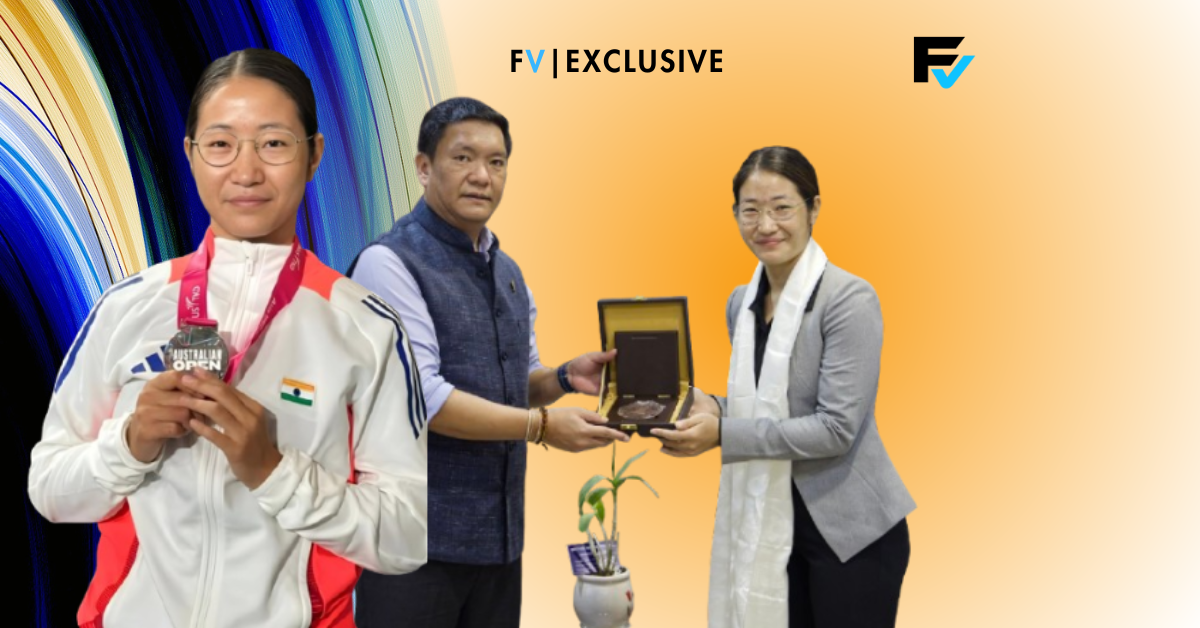

In a nation where sports like cricket, boxing, and wrestling dominate the headlines, Taekwondo has often struggled for recognition. Yet, amidst this scenario, Rupa Beor has emerged as a trailblazer, putting Indian Taekwondo on the world map.
While Taekwondo is firmly established as an Olympic sport, specific disciplines within it, such as Poomsae, are not yet part of the Olympic roster. However, these disciplines have garnered recognition on prominent international stages, including the Asian Games, the World Championship, and the Asian Championship.
In an exclusive interview with Field Vision, Bayor shared her insights into the significance of Taekwondo, its evolution, and her aspirations to see all aspects of the sport shine globally.
Early beginnings: From Karate to Taekwondo
Rupa Bayor’s introduction to martial arts began with Karate under the mentorship of her uncle, Thabu Sehra, who was also her first master. However, it was in 2015 when her uncle recommended transitioning to Taekwondo, citing its inclusion as an Olympic sport. “He believed I was better suited to Taekwondo,” Rupa recalls. From that moment, she embarked on a new journey, one that would define her career.
Bayor further added on by saying, “Because Taekwondo was an Olympic sport, so he thought that I was more suited to Taekwondo than Karate. So he recommended me to Taekwondo in 2015. Since then I have been playing Taekwondo.”
Understanding Taekwondo: A unique art form
Despite being a globally renowned martial art, Taekwondo remains relatively underrepresented in India. “Taekwondo is a beautiful sport,” Rupa explains. “It’s South Korea’s national game and combines techniques of kicking and punching, akin to Karate and Boxing.” Taekwondo has two main categories:
- Kyurugi – A combat-oriented discipline involving fighting.
- Poomsae – A performance-based category focusing on form, rhythm, and precision.
Rupa specializes in Poomsae, a non-Olympic event featured in the Asian Games and World Championships. She is committed to popularizing this lesser-known aspect of Taekwondo in India, stating, “Medals are medals. Performance-wise, both Kyurugi and Poomsae deserve equal recognition.”
The role of family and mentors
Every athlete’s journey is marked by the support of mentors and loved ones. Rupa credits her achievements to her master, Abhishek Dubey, whose guidance shaped her career. “If it wasn’t for him, I wouldn’t have made it this far,” she shares. Financially, Rupa’s journey was challenging, but with the help of her family, her village uncle Tanyaso, and organizations like Wilds One, she overcame these hurdles.
“I’m here today because of the blessings and support of so many good people. Welspun too has helped me with their support in my professional growth. I can’t just say that I have reached this phase on my own. Many good people have helped me reach where I am and I can only thank them ” she lastly emphasized.
From Arunachal to Mumbai: A professional leap
Born in Arunachal Pradesh, Rupa began her professional Taekwondo career in 2021. However, it wasn’t until she joined the Indo-Korean Academy in Mumbai that her ambitions soared. “I had no vision of reaching the world level initially,” she admits. But with exposure to a structured training environment and the support of her coach, Rupa’s confidence grew.
Financial constraints almost derailed her plans, but a scholarship from her academy allowed her to continue her journey. “My coach told me to just train well, and everything else would follow. I believed him,” she said.
Breaking through: The Asian Taekwondo Championship
Rupa’s breakthrough moment came during the Asian Taekwondo Championship, her first major international event. Against all odds, she clinched a bronze medal, making history as one of India’s first medalists in the competition.
“Asia has the toughest competition in Taekwondo,” she explains. “Winning a medal here felt like a monumental achievement.” Despite limited exposure to international events due to federation issues, Rupa’s success showcased her determination and skill.
Achievements and aspirations
As an athlete who has represented her country on multiple occasions, Bayor’s journey has been one of resilience and passion. Her success at the Asian Championship has solidified her position as a leading figure in Taekwondo, inspiring young practitioners to pursue the sport. “Every movement in Taekwondo tells a story of discipline, tradition, and perseverance,” she said, underscoring the profound cultural ties embedded in the martial art.
Reflecting on her career, Bayor emphasized how global platforms like the World and Asian Championships serve as crucial avenues for athletes to showcase their talent and connect with a broader audience. Her dream, however, extends beyond personal accolades. “I hope to see all aspects of Taekwondo represented equally on the Olympic stage. It would be a milestone for all of us who have dedicated our lives to this art.”
The Road ahead
While progress has been made in raising the profile of Taekwondo, Bayor believes there is still work to be done. With its inclusion in the Asian Games and the establishment of dedicated championships, the sport is steadily gaining visibility. She remains committed to advocating for equal recognition of all Taekwondo disciplines on the global stage.
As the conversation drew deeper, Bayor left a powerful message for aspiring athletes: “Stay true to your practice, and remember that every step you take is a step towards making history.”
The second part of the interview will published in the next few days
Follow Fieldvision on Youtube ,Twitter , Facebook Instagram and Whatsapp Channel for more updates.


Leave a Reply