


In this story, we highlight not one but two protagonists of Indian hockey, focusing on roles often underrated in a sport demanding high awareness, body alignment, and sharp intelligence to neutralize threats and protect the team’s fortress.
The midfield is an unappreciated role, requiring relentless stamina to cover the pitch from your 23m defensive zone to the opponent’s attacking 23m. It demands a unique skillset to stay strong on the ball when receiving and transitioning from defense to attack, even in high-pressure, crowded zones.
Meanwhile, the defensive line belongs to players who are technically secure with the basics. They know when to hold possession, distribute the ball, and make critical interventions to keep the game under control.
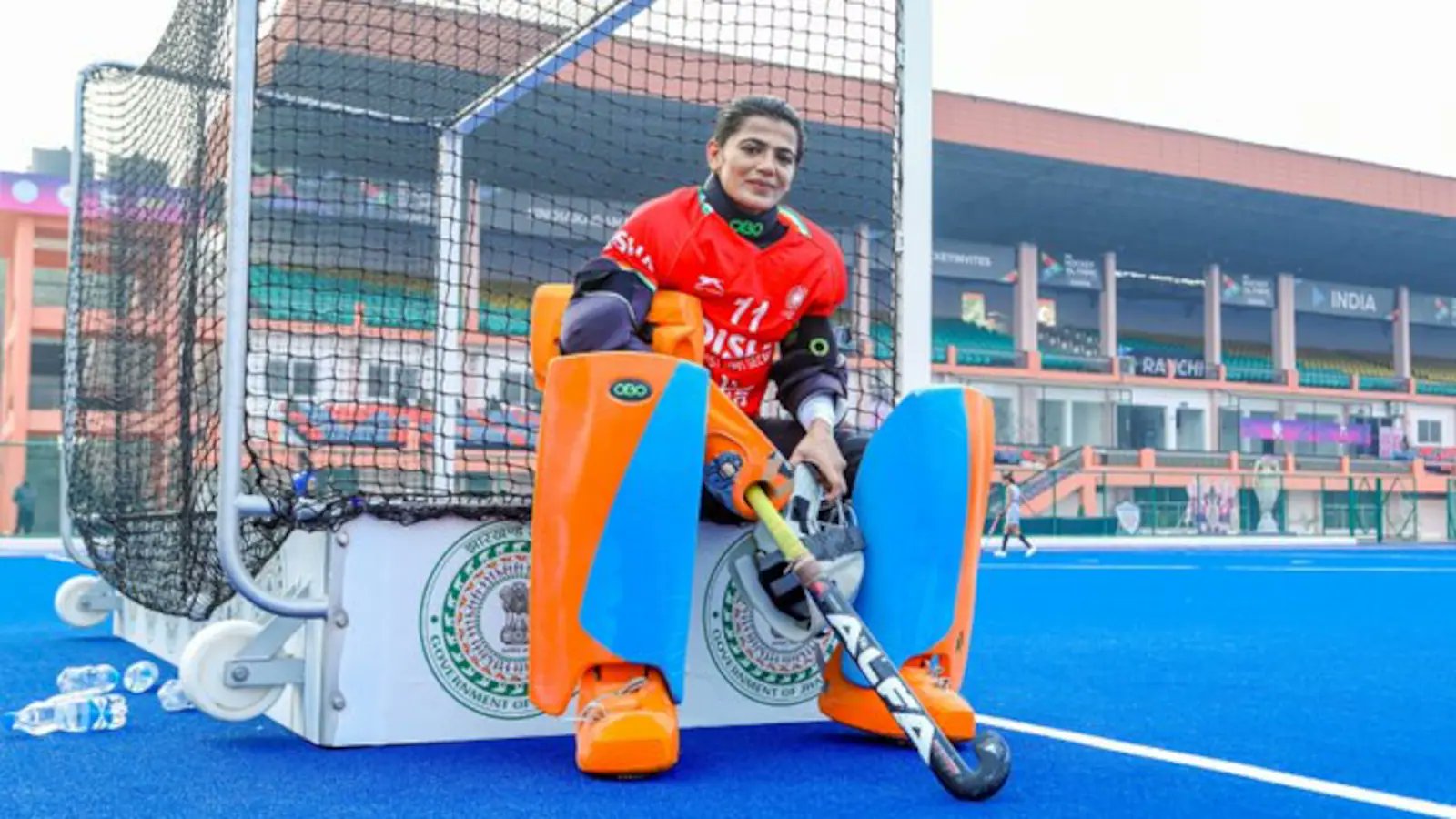
Delving deeper, about this subject we are going to talk about two prospects of Indian Hockey, Salima Tete and Jyoti Rumavat.
Salima Tete is the organizer for the Indian Women’s Team. She brings stability to both attack and defense. Playing roles like right midfielder, she carries the ball to create wider threats and balances the team with smart positioning to read and intercept opposition passes, covering for teammates.

She can shift into central midfield or drop to the defensive line to ensure smooth transfer of the ball in midfield pockets to outlet and initiate the action from defense to attack.
Her game intelligence helps her decide when to push forward, when to stay back, and how to support teammates to gain numbers in key areas. Salima’s all-action style makes her vital to India success.
Jyoti Rumavat emerges as a potential defensive leader, known for her bravery and bold attitude, which truly reflect her skill level as she aggressively neutralizes threats. She scans the area of attack from different angles and intercepts passes in the shooting circle. Covering the pitch from right centre half (RCH) to left centre half (LCH) and even fullback areas, she sweeps dangers and shadows wide threats to delay attacks until support arrives. Her deeper positioning adds security.

During build-up play, she stays deep but can surge into midfield when India attacks. She is proactive in reading and tracking the threats when caught in transition.

Field Vision had an incredible opportunity to connect with India’s modern-day stars, who have been instrumental in driving the team’s success.
Q: Can you tell us about the national camps, including the conditioning, framework, and facilities provided? How do they condition and prepare your body, and which level of periodization is preferred?
Jyoti Rumavat: At the national camp, we train at the Sports Authority of India (SAI), which offers numerous facilities. We have a gym, a hockey tower, tracks, recovery sessions, a psychologist, and everything is managed externally. The food is prepared according to nutritional requirements. We have an advanced gym with a track, a pool, and all necessary facilities.
On the training aspect, we primarily focus on the basics. We believe that strong fundamentals ensure we don’t drop below a certain performance level. For instance, if we consistently play at a level of six out of ten, solid basics guarantee we won’t fall below that.
Q: India defeated the Netherlands in a shootout. Can you share details about the big game tactics and the instructions coach Harendra Singh gave you?
Jyoti Rumavat: I don’t recall the specifics, but his focus is always on our team’s performance, not the opponent’s. He believes that if we play well, we can win any match, regardless of what the other team does. Our emphasis is on how we play, not on how the opposing team plays.
Q: Regarding the Australia series, I noticed they used a 3-2-2-3 and player marking template during pressing, which made it difficult for India to move the ball from the back. Yet, you created some counterattack opportunities, and it was the kind of game where India could have drawn in the closing stages, but the margin varied. What was the strategy?
Jyoti Rumavat: We adapted to different scenarios in the game, such as using a back three or back five. In the first three matches, we played with a back four, but it wasn’t as effective. In the fourth and fifth matches, we made adjustments. Our coaches noted that we weren’t utilizing certain skills effectively. Sometimes, players become overly cautious during the game. With assistance, if someone helps, it helps us to use high balls, and it worked for us.
Which system suits you better—back three or back four?
Jyoti Rumavat: It depends on the team and how the opponent presses. If they use a full press, we opt for a back four. Sometimes, we switch to a back five. It’s about adapting to the opponent’s strategy. In a back four, we have three midfielders. It allows link-up of defenders with midfielders, but connection with strikers becomes difficult. When we play with a back three, we get more options in the build-up, and we can play higher up the field. The setup varies by the state of the game.
Q: In the Hockey India League (HIL), you played with players like Maria Verschoor and others. What’s the experience like? How do you connect with them?
Jyoti Rumavat: The dressing room atmosphere is relaxed. We don’t talk much; we have meetings, sit together, chill, and listen to music. Their mentality is different—they give 100% in every game, whether it’s a practice match or a competitive one. They never take any game lightly, which is something we’ve learned from them. They’re both relaxed and serious.
Salima Tete: When things aren’t going well, they motivate everyone. In the changing room, we discuss mistakes at halftime and plan what we need to do. The communication within the team is excellent, and we have a great combination. We had a fantastic match, and we’re definitely looking forward to winning the gold medal in the coming years with Soorma Hockey Club in the Hockey India League.
When you played under Jude Menezes in the HIL and Janneke and Harendra Singh for the Indian team, how do you compare the two coaches? How do their training programs and technical work differ?
Jyoti Rumavat: When we played with Jude Menezes in the HIL, he was a calmer coach and didn’t shout much. Harendra Sir, on the other hand, provides instructions from the sidelines during the game. Jude gives instructions at specific times, and his strategy is clarified in meetings—what to do and what not to do. Harendra Sir also has a strategy but makes on-field adjustments if something isn’t working. They adapt during the game. Both are good in their own right and have different personalities.
Salima Tete: From my experience playing under them, I feel all the coaches are quite similar; there’s no notable difference. For me, they’re all equal, and I really like everyone’s training approach. For instance, I also really like the training under Harendra Sir. Each coach has a slightly different structure, but the core is the same. Some coaches emphasize small games or specific aspects of play, but that doesn’t mean any coach is better or worse.
For me, Honestly, all coaches are equal. If I had to choose, I’d say they’re all great. Regarding communication, sometimes there’s a slight issue, like with Janneke Schopman or the assistant coach. Initially, there was a language barrier, especially for those who didn’t understand English, but we explained things, and over time, everyone started understanding. It took a bit, but we got there.
Q : In the Hockey India League (HIL) finals, Did you make any specific plans from Hockey India League finals the final, like how to isolate their key players in the like Yibbi Jansen and win those crucial midfields duels?
Salima Tete: Our plan was to ensure we didn’t let the world’s number-one Drag Flicker (Yibbi Jansen) score against us in PCs. We had already beaten them in the group stage, so our plan worked to some extent, though the margin was close in three games.
Q: With Jharkhand’s recent success in the Hockey Nationals and strong representation from players like yourself, can you share insights on the state’s sports culture and any advice for aspiring athletes from Jharkhand?
Salima Tete: We have some raw talents in Jharkhand, with players like Sangita Kumari, Nikki Pradhan, and recently my sister, Mahima Tete, who is part of the camp. We have a football hub in Gumla, and my hometown, Simdega, is now recognized as a hockey center. Many players from the Nationals have been given opportunities in the National Camp. This is a great platform to practice and improve. It’s all about hard work.
At Fieldvision, We Salute the Bravery and Valour of the Indian Armed Forces. Support our soldiers by donating directly to the National Defence Fund here.
Follow Fieldvision on Youtube ,Twitter , Facebook Instagram and Whatsapp Channel for more updates.


Leave a Reply