
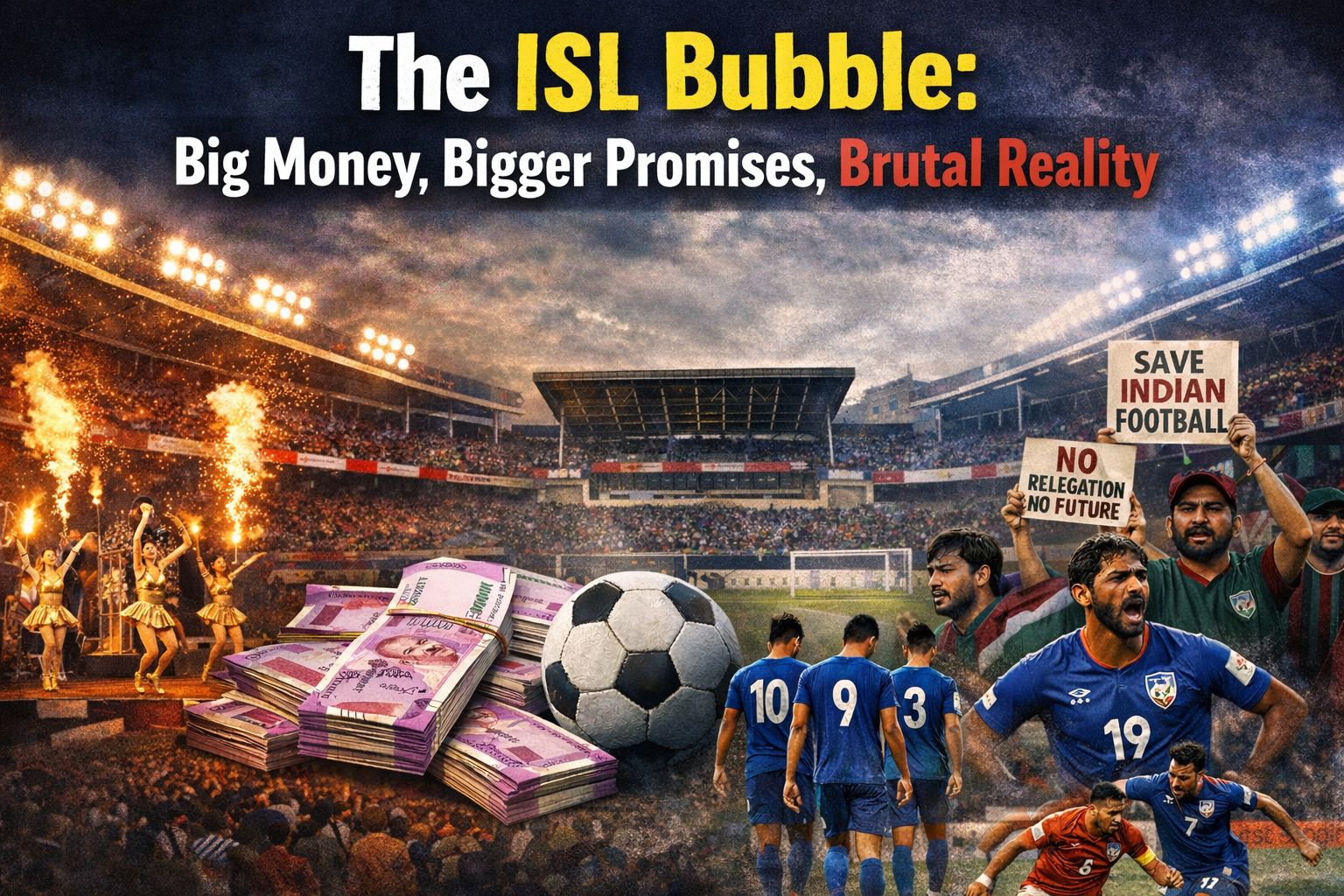

Introduction: A revolution that promised everything
When Football Sports Development Limited entered Indian football in the early 2010s, it was sold as nothing short of a revolution. Glossy presentations promised packed stadiums, global attention, elite professionalism, and a long-awaited footballing renaissance. The Indian Super League was marketed as the product that would finally “fix” Indian football—commercially, structurally, and competitively.
Fifteen years later, Indian football finds itself at a crossroads—and not the triumphant one that was promised. While the sport is richer, shinier, and louder than ever before, uncomfortable questions now dominate the discourse: Did Indian football actually improve? Or did it merely become more expensive? Did the ISL era nurture the ecosystem—or cannibalise it?
This report examines the last 15 years of Indian football under the FSDL–ISL model: what changed, what disappeared, who benefited, who suffered, and whether the sport is truly better off—or merely trapped inside a glamorous bubble on the verge of collapse.
1. Before the money: Indian football before FSDL
Prior to FSDL’s arrival, Indian football was modest, chaotic, and deeply underfunded—but it was also organic. The I-League, despite its flaws, was an open pyramid. Clubs like Mohun Bagan, East Bengal, Dempo, Churchill Brothers and Sporting Clube de Goa operated within promotion and relegation, Asian qualification pathways were clear, and state leagues fed into a national structure.
Stadiums were rarely full, marketing was primitive, and players earned modest wages—but the system had continuity. Clubs rose and fell on sporting merit. The national team was inconsistent but not disconnected from the domestic ecosystem.
That world effectively ended after 2014.
2. The ISL arrives: glamour over governance
The launch of ISL in 2014 was revolutionary in optics. Franchise owners included Bollywood stars, corporate tycoons and global brands. Foreign stars—some semi-retired, some still elite—were flown in to legitimise the spectacle.
But the model came with a catch: closed franchises, no relegation, and centralised control. Indian football was no longer being built bottom-up; it was being engineered top-down.
While the All India Football Federation officially sanctioned the league, real power over calendars, commercial decisions and media narratives increasingly rested with FSDL.
The result was immediate attention—but also structural distortion.
3. Tournaments that vanished, traditions that shrank
One of the earliest casualties of the ISL era was India’s traditional competition calendar.
Major changes and losses:
- Federation Cup (ended 2017): Once India’s premier knockout tournament, it was scrapped and replaced by the Super Cup—less prestigious, inconsistently organised, and often treated as an afterthought.
- I-League marginalisation: While not abolished, the I-League was gradually stripped of relevance. Top players migrated to ISL franchises, sponsors followed TV exposure, and legacy clubs were pushed into financial uncertainty.
- State leagues weakened: With ISL franchises dominating attention, state leagues lost commercial relevance, reducing grassroots visibility.
The revival of the Durand Cup in recent years has been celebrated—but even that revival primarily serves ISL clubs’ pre-season needs rather than rebuilding the pyramid.

4. The money explosion: budgets and salaries spiral
There is no question that Indian football became richer.
Club budgets:
- Pre-2014 I-League club budgets typically ranged between ₹3–7 crore per season
- ISL club budgets by the early 2020s ballooned to ₹40–100 crore per season, with some clubs exceeding that figure
Player salaries:
- Average Indian top-flight salary pre-ISL: ₹6–12 lakh per year
- ISL era top Indian players: ₹1–3 crore per year
- League-wide annual wage bill (2023–24 estimates): ₹400–500 crore
On paper, this looks like progress. In reality, it created one of the most distorted wage-to-performance ratios in Asian football.
Indian players—ranked outside Asia’s top 15 national teams—began earning more than counterparts in countries with superior continental records and stronger leagues. The market was inflated not by productivity, but by scarcity inside a closed franchise system.
5. Asian performance: the inconvenient truth
If money and marketing were the metrics, the ISL era would be an undisputed success. But football is ultimately judged on the pitch—and here the narrative collapses.
Clubs in Asia:
The high-water mark remains Bengaluru FC reaching the final of the AFC Cup in 2016. That achievement, notably, came from a club built with strong youth integration and long-term planning—not glamour spending.
Since then:
- Indian clubs have rarely progressed deep into Asian competitions
- Group-stage exits have become routine
- ISL clubs struggle against even mid-tier Southeast Asian opposition
National team:
Despite periodic ranking spikes, India’s FIFA ranking has fluctuated wildly and often regressed. Qualification failures, tactical stagnation, and an alarming inability to dominate even regional opponents expose a hard truth: domestic commercial success has not translated into international footballing growth.

6. The illusion of development
ISL defenders often argue that academies, infrastructure, and youth systems have improved—and this is partially true. Some clubs have invested meaningfully in training facilities and youth pathways.
But the ecosystem remains uneven:
- A handful of clubs run serious academies
- Many franchises outsource youth development or treat it as a compliance requirement
- Player minutes for young Indians remain limited due to short-term results pressure
Crucially, the franchise model discourages patience. Without relegation, clubs prioritise immediate outcomes, often recycling the same domestic players at inflated wages rather than developing new ones.
7. Who benefited—and who paid the price
Beneficiaries:
- Corporate owners and broadcasters
- A small pool of Indian players who secured life-changing contracts
- Sponsors and advertisers riding the football boom
- Urban fans exposed to higher-quality matchday production
Casualties:
- Traditional clubs forced into uncertainty or debt
- Second-division players squeezed by reduced opportunities
- State associations sidelined from the national conversation
- Fans alienated from clubs that lost identity or continuity
Indian football did not grow evenly—it concentrated wealth at the top while hollowing out the base.
8. Governance chaos and recent cracks
The past two years have exposed the fragility of the ISL era model. Legal disputes, uncertainty over commercial rights, delayed calendars, and questions about long-term sustainability have shattered the illusion of stability.
With club owners questioning return on investment and administrators scrambling for control, the very system that promised professionalism now looks alarmingly fragile.
Indian football has never been richer—and never more uncertain.
9. The final verdict: progress or expensive stagnation?
Fifteen years after FSDL arrived, Indian football stands accused—not of failure, but of misdirection.
Yes, the game looks better.
Yes, players earn more.
Yes, sponsors arrived.
But the fundamentals remain unresolved:
- The pyramid is distorted
- Asian competitiveness is weak
- Financial sustainability is questionable
- Governance lacks clarity
- Development remains selective, not systemic
The ISL era did not destroy Indian football—but it redefined success in purely commercial terms, often at the expense of sporting logic.
Conclusion: A reckoning is inevitable
Indian football cannot survive on glamour alone. The next phase must confront hard truths: cost controls, genuine promotion and relegation, transparent governance, and youth development that serves football—not television slots.
Otherwise, the ISL era risks being remembered not as a revolution—but as the most expensive missed opportunity in Indian sporting history.
The money came.
The lights shone bright.
But the football?
It never truly caught up.
Follow Fieldvision on Youtube ,Twitter , Facebook Instagram and Whatsapp Channel for more updates.


Leave a Reply