
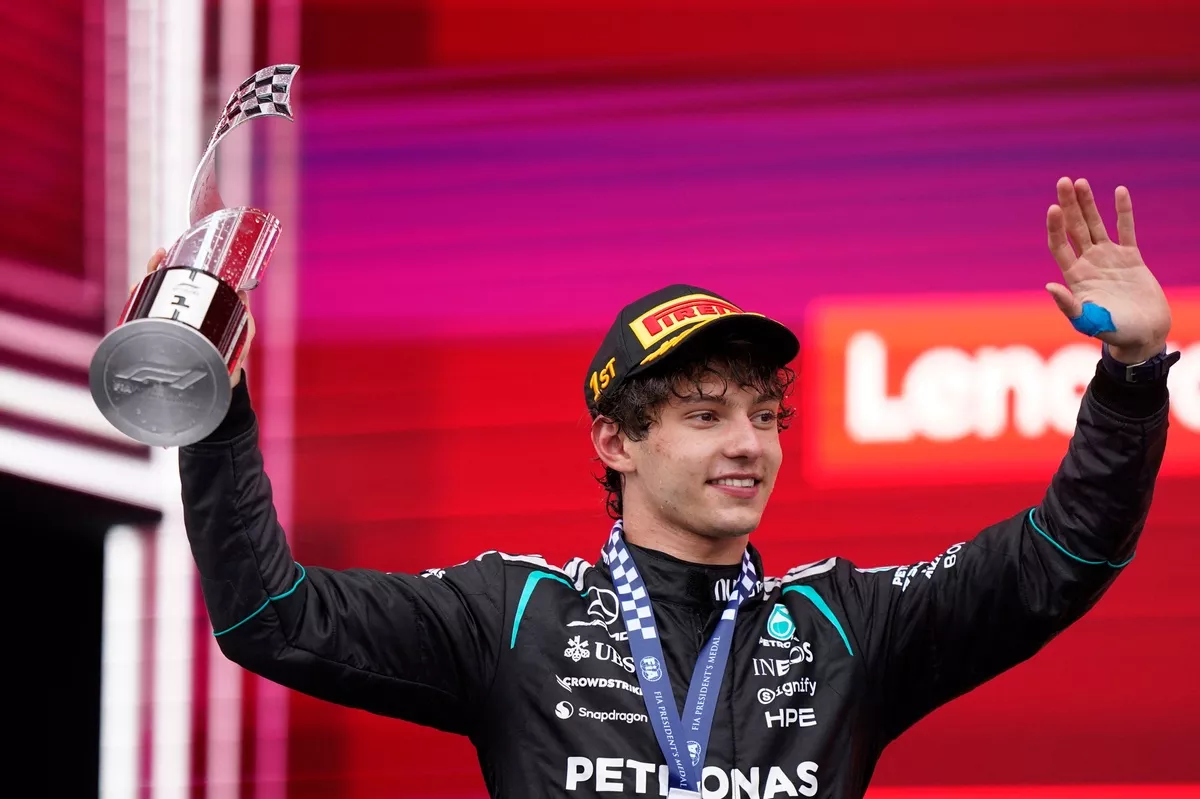
Montreal doesn’t do boring Sundays. It does wall-scraping chicanes, grandstands that stay loud whether the race deserves it or not, and a circuit that has a habit of breaking cars and ambitions in equal measure. This one delivered on all counts.
The 2026 Canadian Grand Prix had everything the sport promises and rarely delivers in the same afternoon: a civil war inside the dominant team, a championship swinging violently on a broken power unit, two legends rediscovering why they loved racing each other, and a teenager fighting against all the odds to finish fifth.

By the time the chequered flag fell over Circuit Gilles Villeneuve, Kimi Antonelli had won his fourth consecutive race, but the story was never really about him. It was about everyone else falling apart around him.
Here are the four things that actually mattered.
The Cold War Inside the Silver Arrows
There’s a moment, you probably know the one, where two teammates stop racing the field and start racing each other, and the whole paddock collectively holds its breath. Montreal gave us thirty laps of that. Then it gave us a headrest thrown in fury, and a 19-year-old driving off into the distance.
Kimi Antonelli locked up at the hairpin on Lap 24, Russell was ahead, but barely. The pair went wheel-to-wheel into the final chicane, Pirelli paint rubbing off, and Antonelli was forced over the grass before rejoining in front. Mercedes issued a swap instruction. Antonelli pushed back on his engineer: “Why mate?! He pushed me off, and I was ahead! What’s the point?” He relented anyway. That restraint lasted approximately six more laps.

Russell’s engine gave up on Lap 30. He was leading when he hit the brakes for the Turn 8-9 chicane and lost power, parking his Mercedes on exit, angrily throwing his headrest out of the stopped monocoque and punching the car as he pulled himself out of the cockpit.
That image tells you everything about where George Russell’s head is right now. This wasn’t a man accepting hard luck. This was a man who knows exactly what just happened to his title campaign. The biggest thing today is the 25 points versus zero. The arithmetic is brutal: Russell could now beat Antonelli in three consecutive all-Mercedes victory duels and still be one point short of negating the impact of today.
The uncomfortable truth that Mercedes must now confront: they no longer have a clear number one driver, they have two men who genuinely believe they deserve to win the championship, and one of them is starting to act like it. Antonelli’s lead stretches to 43 points. Toto Wolff has watched his car dominate four races in a row. He’s also watched his garage turn into a theatre of internal conflict he hasn’t seen since the Hamilton-Rosberg years. The boy wonder tag is gone. What replaces it is Wolff’s problem to manage.
Mclaren’s Intermediate Gamble
Picking the right tyres in mixed conditions is never straightforward, but putting both cars on intermediates on a track that clearly wasn’t wet enough for them was a mistake that required no hindsight to identify. What made it worse was the timeline. By Lap 5, all intermediate starters had swapped to slicks. Five laps. The entire strategic call lasted five laps.
Before the race, Piastri’s radio suggested he had doubts about the compound choice. The call was made anyway. Norris briefly led before the inevitable pit stop, but his race was already compromised well before he retired with a reported gearbox issue. Piastri compounded the misery: he punted Alex Albon’s Williams at the hairpin, and the resulting damage and 10-second time penalty ended any meaningful recovery.

Here is the question that should be keeping McLaren’s strategists awake tonight: how does a team supposedly fighting for a constructors’ championship look at a damp-but-drying Montreal circuit, account for two formation laps that dried it further, and still send both cars out on intermediates? The data would have told them. Piastri’s pre-race radio suggested he had doubts. The call was made anyway. That’s not a tyre model failure. That’s a cultural one, the kind where confidence in a process overrides evidence in front of your eyes.
Hamilton vs Verstappen: The Fire Still Burns
In the post-race cooldown room, both men were candid about the exchange. Verstappen was open about where he’d found his margins; Hamilton was equally direct about what had made the overtake possible. The competitive respect between them, built across fifteen years and multiple near-misses, was palpable. These are no longer men with something to prove to each other. They’re men who simply enjoy the problem the other one presents.
“I couldn’t shake you!” Hamilton smiled. Verstappen replied: “The middle chicanes, every time you’d pull three tenths, but then I just got it back on the straight.” Hamilton added: “It was mad.”

For a certain vintage of F1 fan, that exchange lands differently. These are the same two men who nearly ended each other’s seasons at Silverstone, Monza, and Jeddah. Now they’re sitting in the cooldown room picking apart each other’s braking points like it’s a pleasant Sunday afternoon. The world has genuinely turned upside down.
But don’t mistake warmth for a lack of edge on track. What these two produced over the final twenty laps was the race within the race, the kind of sustained, high-pressure duel that reminds you why the Hamilton-Verstappen era defined a generation, and why neither man is ready to stop defining this one.
Hamilton finally got it done on Lap 62, going around the outside of Verstappen into Turn 1 to snatch second, a move that required patience through six laps of dirty air, a perfectly-read chicane exit, and the kind of late-braking commitment that younger drivers talk themselves out of. At 41, it was his best result in a Ferrari uniform, and his second podium of what has become a much-improved 2026 season.
Verstappen, meanwhile, was fighting a Red Bull that was struggling heavily with medium-tire warm-ups, and still nearly held on. The machinery has let him down repeatedly this year. The driver hasn’t. This was his first podium of the season, extracted from a weekend that offered him considerably less than he deserved.
Chaos, Penalties, and the Red Bull Junior Dilemma
Isack Hadjar is a fascinating problem. Not a bad one, a genuinely fascinating one.
Hadjar was handed a 10-second penalty for weaving on the straight, a move that almost led to a high-speed collision, and then picked up a stop-and-go for ignoring yellow flags. Two separate penalties, two separate categories of error: one tactical, one concentration. He still hung onto fifth because the gap to the midfield was large enough to absorb the damage. That’s the thing about Hadjar, the pace bails him out. Until it won’t.
The penalty for weaving under braking is not a rookie mistake. It’s an experienced driver mistake, the kind born of believing you can do things the rulebook explicitly prohibits. Red Bull’s junior programme has produced Verstappen and must now determine whether Hadjar’s rough edges get refined, or whether they get him, and someone else, seriously hurt.

Compare his afternoon to Franco Colapinto’s. The Argentine quietly dragged his Alpine to P6 through clean laps, intelligent positioning, and zero drama from a car with no right to be that far up the order. Colapinto didn’t need to be spectacular. He needed to be precise, and he was. Liam Lawson finished P7 for Racing Bulls in a similar vein; composed, efficient, points banked.
The contrast is a portrait in development stages. Hadjar has the raw ceiling of a future champion. He also has the racecraft of someone who still occasionally drives like the car is invincible.
Colapinto, for his part, keeps making the argument that Alpine stumbled into something special when they signed him. P6 in Montreal with no drama, no mistakes, and an energised radio at the finish? It was, by his own description, a “perfect day.” In a race full of implosions, that kind of Sunday is quietly devastating to the teams above him in the standings.
In a nutshel..
That’s the 2026 season in miniature: relentless, unpredictable, and increasingly unkind to anyone who assumes Sunday will look like Saturday. Antonelli has 43 points on Russell now. The gap looks comfortable until you remember Russell built it with him, and knows exactly how to close it.
Monaco is next. The walls are closer there. So is everything else.



Leave a Reply