
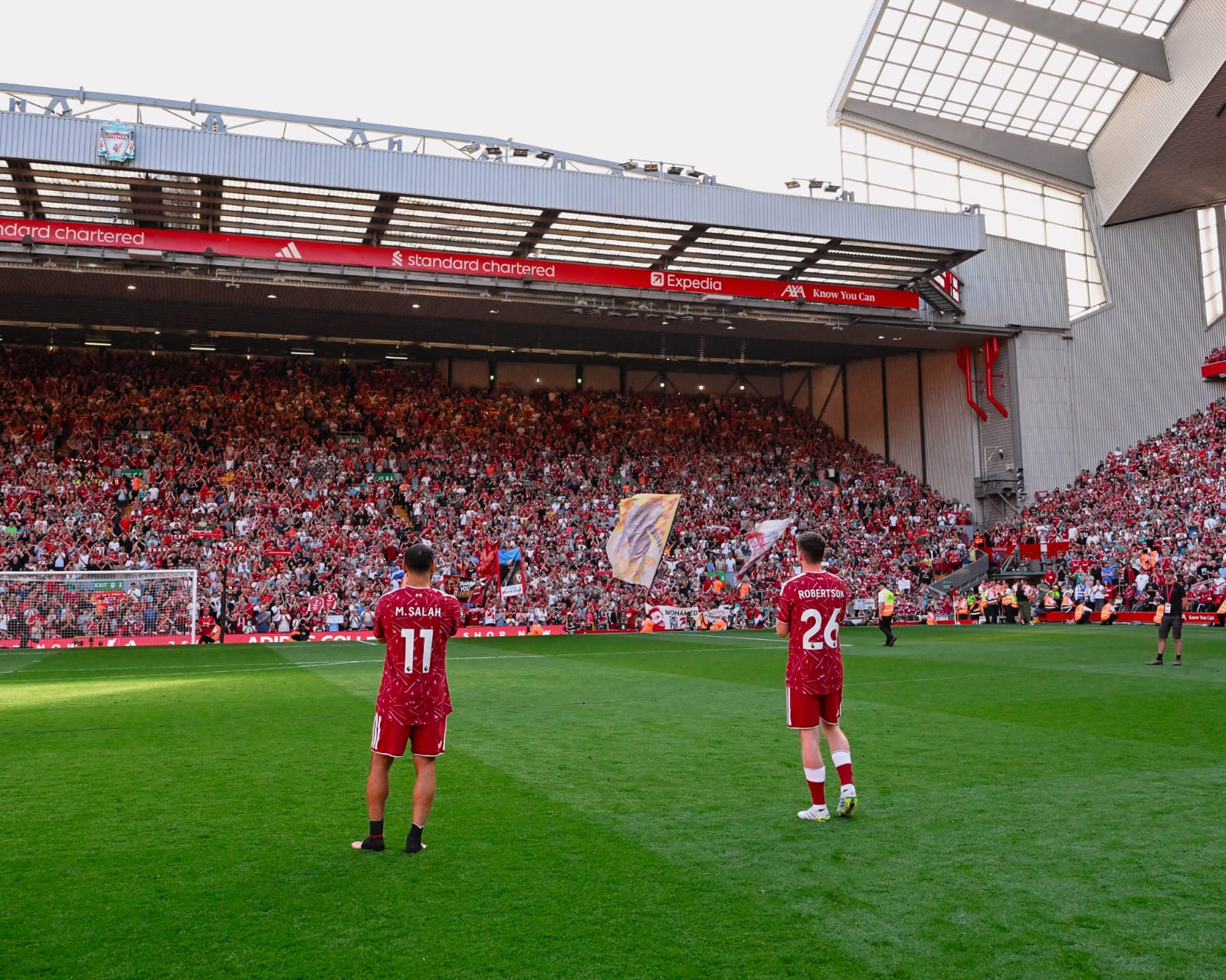
There are football clubs, and then there are footballing memories that become inseparable from the story of one’s own life. For nearly a decade, Liverpool F.C. under Jürgen Klopp became exactly that — not merely a team chasing trophies, but an emotional inheritance carried every weekend by millions who laughed, cried, screamed, believed, and broke with them.
And today, as the curtain falls on another Premier League season, it feels as though an era itself exhales for the final time.

The city says goodbye to its Egyptian king.
Mohamed Salah arrived at Liverpool in 2017 carrying the scars of rejection from England. His time at Chelsea F.C. had left many unconvinced. There were whispers that he was too lightweight, too erratic, too incomplete for the Premier League. But football has a beautiful way of humbling certainty. Under Klopp — the charismatic revolutionary with his thunderous smile and “heavy metal football” — Salah did not merely rebuild himself. He transcended.
What followed was not simply success. It was mythology.
Klopp’s Liverpool was built on emotion as much as tactics. It was pressing that felt like fury. Counterattacks that arrived like avalanches. The football was courageous, relentless, and human. He built a front three that would go on to define an era: Salah, Sadio Mané, and Roberto Firmino.

Each was essential in its own way.
Mané was chaos incarnate — explosive, direct, impossible to cage. Salah was the goalscoring maverick, the assassin who turned impossible angles into inevitabilities. And Firmino, sweet Bobby, was the glue binding it all together: the false nine who sacrificed numbers so the others could become immortal. He was the rhythm beneath the orchestra.
Together, they terrorised defences across Europe.
And through all of it stood Salah — gliding across the right flank with that unmistakable body feint, curling the ball into the far corner so many times that it began to feel scripted by destiny itself.
Two hundred and fifty-seven goals.
Third-highest goalscorer in Liverpool history.
Numbers large enough to demand reverence, yet somehow still inadequate in explaining what he truly meant.
Because Salah’s impact stretched beyond football.
In a world increasingly poisoned by division and suspicion, he became a figure who softened hearts. A study found that Islamophobia and hate crime rates reduced in Liverpool during his time at the club, with chants from the terraces celebrating not just a footballer, but a Muslim man embraced by an entire city. Football rarely changes society in grand revolutions, but sometimes it changes ordinary people in small, meaningful ways. Salah did that. Quietly. Humanely. Powerfully.

Children copied his celebration. Parents wore his shirt. Mosques echoed with pride. And for many immigrants and Muslims watching around the world, there was comfort in seeing one of their own become beloved in one of football’s most historic cities.
Last season felt like the final symphony of his greatness.
Liverpool won their 20th league title, and Salah delivered one of the most staggering individual campaigns English football has ever seen: 30 goals and 22 assists in 39 appearances. Fifty-seven goal involvements — a number so absurd it tied all-time Premier League records. At an age when most wingers begin fading, he evolved again. Sharper. Smarter. More complete. It was not merely productivity; it was mastery.
And now, somehow, it is over.
Mohamed Salah, a gift from Allah
He came from Roma to Liverpool
He’s always scoring
It’s almost boring
So please don’t take Mohamed away
The image of Salah waving goodbye feels impossible to process because some players stop belonging to clubs and begin belonging to memory itself. Anfield without Salah feels like a cathedral missing its stained glass. You can still gather there. You can still sing. But something luminous is gone.
Yet no tribute to this era can exist without speaking of another warrior who arrived in the same summer and became the living embodiment of Klopp’s spirit.
Andrew Robertson.
Oh Andy Andy! Andy Andy Andy Andy Robertson!

A Scotsman carved from grit and stubbornness.
If Salah represented brilliance, Robertson represented belief.
He came from Queen’s Park F.C., from amateur football, from rejection by his boyhood club Celtic F.C., from uncertainty and hardship. There was once a tweet — painful in hindsight — where a young Robertson spoke about having no job and life being difficult. Few could have imagined then that the same boy would one day lift the UEFA Champions League and the Premier League as captain on certain nights for Liverpool Football Club.
Football romanticises struggle often, but Robertson truly lived it.
And perhaps that is why the crowd loved him so fiercely.
He wore his heart on his sleeves every single match. He was always the first to press, the first to sprint, the first to fight. Klopp’s football demanded courage from fullbacks — impossible stamina, endless running, emotional commitment — and Robertson became its purest disciple. Fifty-six assists from left-back. One of the greatest to ever play the position.
But statistics never fully captured him. You remember moments instead. Atleast for football romantics like us who like to see the picture rather than the paints.
The manic pressing against Manchester City F.C. when Anfield sounded like a volcano. The snarling competitiveness. The way he wound up Lionel Messi during that unforgettable European night at Anfield, embodying the refusal to surrender that made Klopp’s Liverpool special.

Robertson played football with a Glasgowian grit that made supporters feel represented. He was not polished royalty. He was one of them — angry, relentless, emotional, cheeky, defiant. The kind of player who reminds fans that effort itself can become art.
And now, as this era closes, it feels right that Salah and Robertson are spoken of together. Two men from vastly different worlds who arrived in the same year and helped reshape Liverpool’s identity forever.
One gave the club majesty. The other gave it steel.
But perhaps what makes this season feel so haunting is that football itself became secondary for long stretches.
Before the season had truly begun, tragedy struck.
Diogo Jota was gone. An accident that was sudden, cruel and truly unimaginable.
Football clubs often speak about family, but in dressing rooms, those bonds are real in ways outsiders rarely understand. These are men who spend nearly every day together — training, travelling, laughing, suffering, eating, dreaming. They share victories, injuries, births, defeats, fears. To suddenly lose someone who occupied the dressing room beside you is not something tactics can solve.
And Liverpool never truly looked the same afterward.
There was a visible heaviness over the season. A silence beneath the noise. Performances became inconsistent, not because players forgot how to play, but because grief changes the texture of ordinary life. The celebrations looked restrained. The smiles looked incomplete. Football, for all its glamour and tribal passion, remains deeply human. And humans struggle to run, press, compete, and dream when mourning sits inside them.
The void Jota left was not merely tactical.
It was emotional.
Every empty seat in the dressing room carried his absence. Every goal celebration reminded them of who was missing. Fans grieved. Players grieved. The club grieved. And in many ways, this season became a painful reminder that football mirrors life more than we like to admit.
It gives ecstasy without warning.
And it takes away without permission.
That is why this ending feels so emotional. Because it is not merely about trophies or statistics or league tables. It is about time. About how quickly eras pass before we realise we are living inside them.
One day you are watching Klopp arrive with wild conviction and laughter.
Then suddenly you are watching him say goodbye.
One day Salah is cutting inside against Watford F.C., scoring four goals and announcing himself to the world.
Then suddenly he is waving farewell to the Kop.
One day Robertson is an underdog from Hull trying to prove he belongs.
Then suddenly he is remembered as one of the greatest left-backs of his generation.
Football moves mercilessly forward. It always has. New managers arrive. New forwards emerge. New songs are sung. But certain teams leave permanent fingerprints on the soul of the sport. Klopp’s Liverpool did exactly that.
They made doubters believe in miracles again.
They turned pressing into poetry.
They gave us nights that felt larger than sport itself.
And above all, they gave us players worth loving not just for what they won, but for who they were.
So today, as Liverpool bids farewell to its king, and as supporters reflect on a season shaped as much by grief as by football, there is only gratitude left.
Gratitude for Salah — the boy from Nagrig, Egypt who conquered England and changed hearts along the way.
Gratitude for Robertson — the Scotsman from Glasgow, whose lungs, fire, and courage became the pulse of Klopp’s revolution.
Gratitude for the memories, the noise, the chaos, the tears, the impossible comebacks, the fists pumping beneath the Anfield lights.
And gratitude, too, for the reminder that football matters precisely because it is fleeting.
Because one day the final whistle always comes.
But some songs continue echoing long after the stadium empties.
Mo Salah! Mo Salah! Mo Salah!
Running down the wing
Salah la la lala la laThe Egyptian King
Follow Fieldvision on Youtube ,Twitter , Facebook Instagram and Whatsapp Channel for more updates.


Leave a Reply