
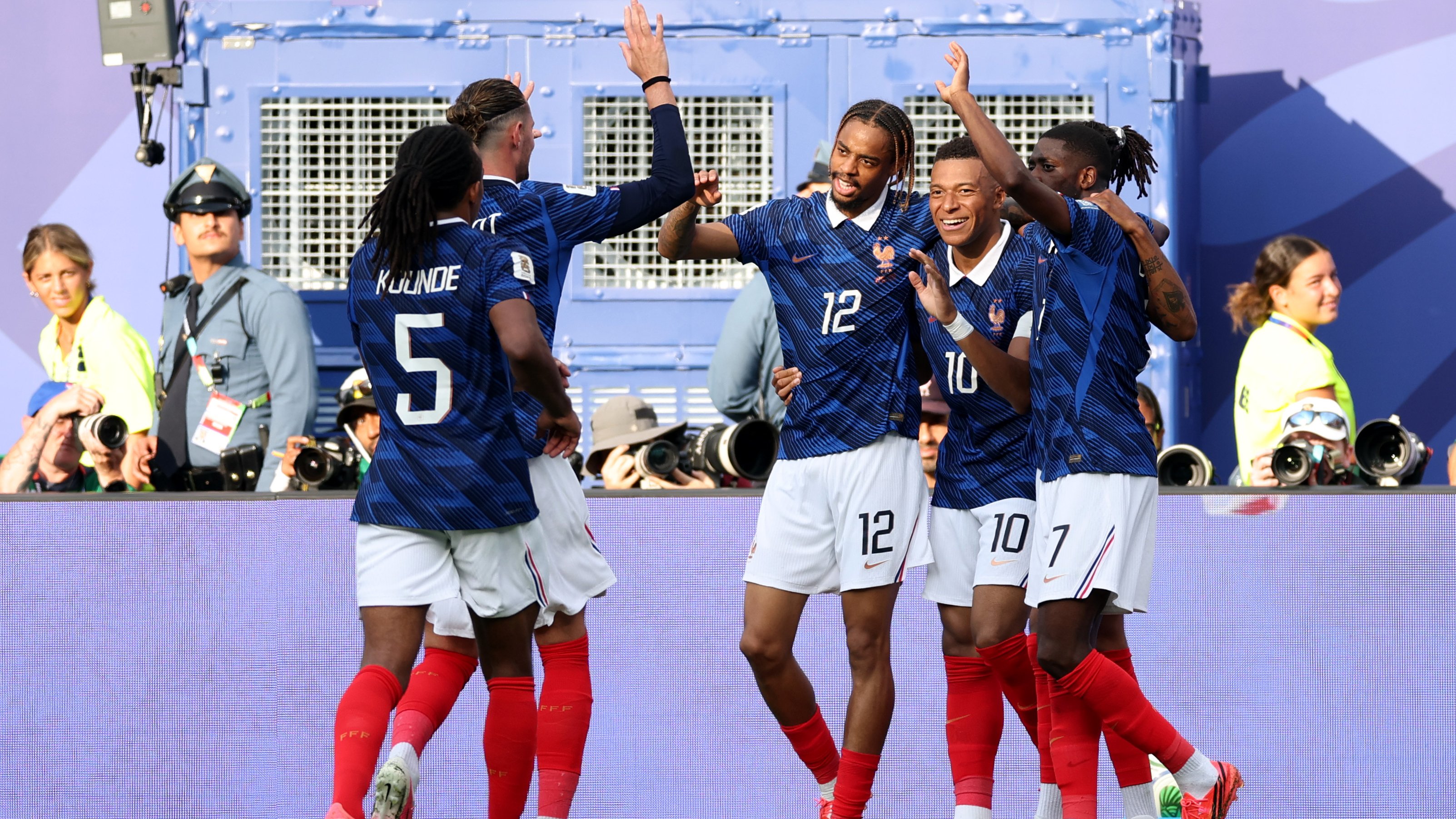
There is a moment, just before the ball leaves the grass and the stadium holds its collective breath, when football stops being a tactical exercise and becomes entirely visceral.
We saw it at MetLife Stadium against Sweden. We saw it when Ousmane Dembele rolled a short corner, Michael Olise caressed it into the half-space, and Kylian Mbappe executed a crossover step so vicious it felt like an eviction of the defender’s balance.
This 2026 FIFA World Cup was supposed to be the tournament of transition, the grueling test of an expanded format across an entire continent. Instead, Les Bleus are turning it into a hyper-modern opera. They have outscored opponents 13-2, becoming the first nation ever to score three or more goals in five consecutive World Cup matches.
Yet, to understand this unstoppable French run, one must look past the heavy metal scorelines and dissect the delicate alchemy of their frontline—and the quiet anxieties that threaten to undo it all.

The Historic Apex of Kylian Mbappe
At 27, Kylian Mbappe is no longer the explosive boy-wonder of Moscow, nor the desperate, tragic hero of Lusail. He is something far more terrifying: a clinical sovereign of the world stage.
His brace against Sweden took his tally to a staggering six goals in just four matches in this tournament, thrusting him to the top of the Golden Boot race alongside Lionel Messi. But the numbers that truly echo in the caverns of football history are 18 goals in 18 World Cup appearances. He has now scored 10 goals exclusively in knockout stages, breaking the all-time tournament record previously shared by Brazilian legends Leonidas and Ronaldo.
Tactically, Didier Deschamps has granted Mbappe the ultimate luxury: functional freedom. He isn’t married to the touchline anymore. He operates in the shadow-striker domain, drifting into the left half-space only when the trap is sprung. When he scored his second against Sweden and immediately ran to embrace Deschamps—who had just returned from France following the tragic loss of his mother—the emotional core of this team was laid bare. This is a group playing with a profound, unified sense of mission.

Dembele and Olise: Chaos and Clarity
If Mbappé is the executioner, Ousmane Dembele and Michael Olise are the architects of the chaos that precedes him.
For years, the critique of Dembele was that he was a beautifully flawed enigma—all speed, no final product. But fresh off a Ballon d’Or-contending year and a Champions League title, the 2026 version of Dembele is a seasoned orchestrator. He stretches defenses until they physically fray. His hat-trick against Norway in the group stage proved his lethal capability, but it is his gravity—the way he forces opposing left-backs to scream for midfield help—that opens the canvas for everyone else.
On the flip side sits Michael Olise, the missing piece of the French jigsaw. Where Dembele is anarchic speed, Olise is calculated elegance. Operating as an inverted playmaker, Olise has already registered a tournament-high five assists.

The Tactical Trap
The synergy of this front three relies on a devastating asymmetrical overload:
- The Iso-Wide Trap: Dembele hugs the right touchline, forcing the opposition to widen their defensive block.
- The Half-Space Exploitation: Olise occupies the inside-right channel, acting as a tactical bridge. If the opponent collapses on him, he switches a diagnostic ball to the left.
- The Fatal Release: This leaves Mbappe isolated against a retreating, isolated center-back. It is a mathematical certainty disguised as a football match.
The Fragile Underbelly: A Danger Unaddressed
To paint this French team as flawless, however, would be a journalistic disservice. Every empire has its fault lines, and France’s weakness lies directly beneath the floorboards of their brilliant attack.
Because Deschamps commits three natural forwards to high, aggressive positions, the defensive transition is heavily reliant on the physical workload of Aurelien Tchouameni and Manu Kone. When France loses possession high up the pitch, there is a gaping canyon between the back four and the front press.
Against Sweden, and occasionally during the group stage against Norway, quick-passing sides found joy by bypassing the initial French press and attacking the spaces behind full-backs Jules Kounde and Theo Hernandez. A team with a world-class transitional midfield—like a potential semi-final opponent—will not be as forgiving as the teams Les Bleus have blown away so far.
Furthermore, there is a psychological fragility to their dominance. France plays with such a high emotional temperature that when things turn stale—as Mbappe admitted they did during a “timid” opening half against Sweden—they can look momentarily paralyzed.

The Verdict
As France heads to Philadelphia to face Paraguay in the Round of 16, they carry the undeniable aura of tournament favorites. They are a team balanced on the edge of historical greatness and tactical high-wire acting.
If their midfield engine can continue to survive the structural gaps left by the front three, we are not just witnessing a team marching toward a trophy. We are witnessing the definitive peak of Kylian Mbappe, flanked by a supporting cast that has turned the hardest tournament on earth into their personal playground.
Follow Fieldvision on Youtube ,Twitter , Facebook Instagram and Whatsapp Channel for more updates.

Leave a Reply