
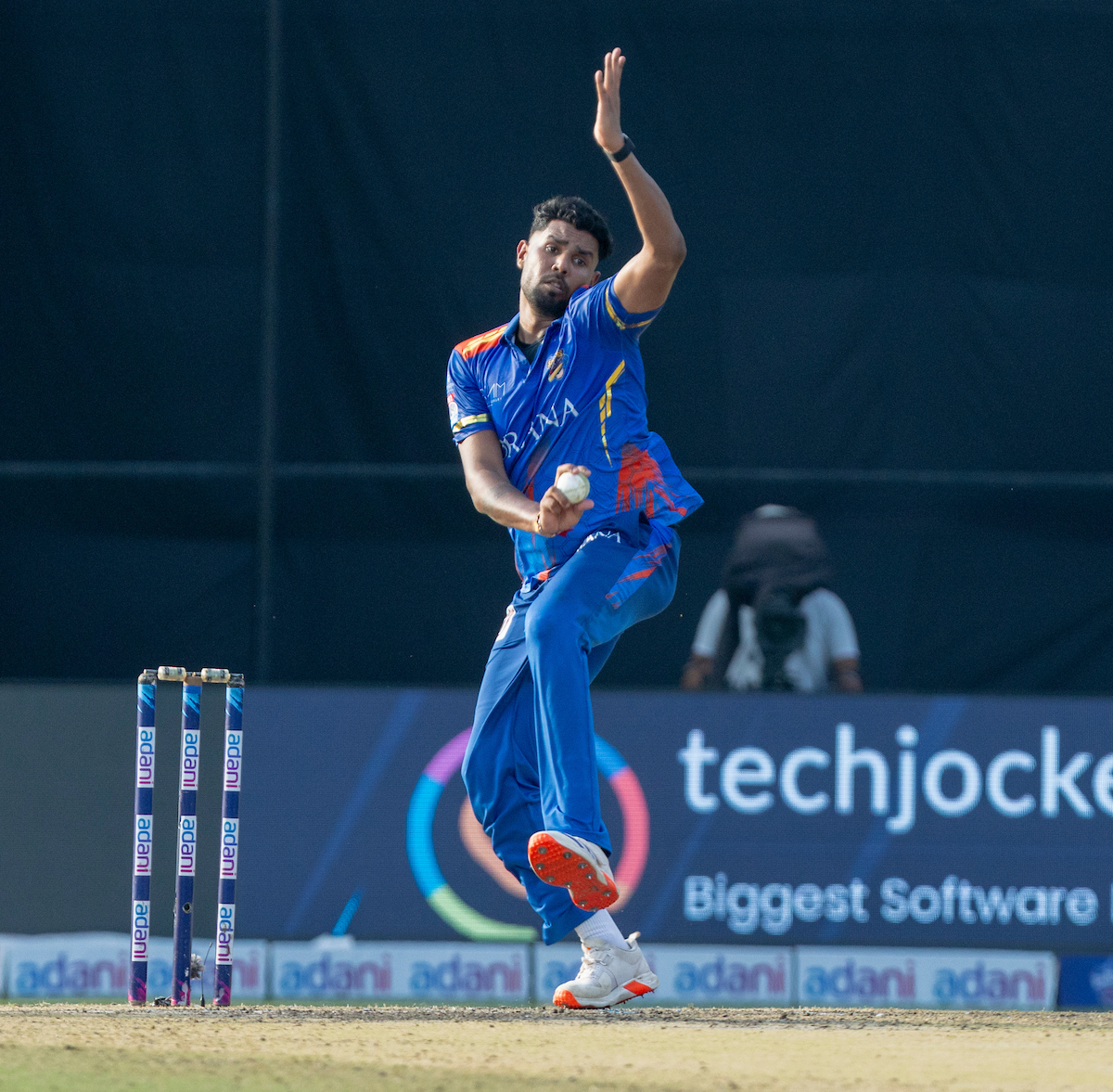

Harshit Rana has consistently pitched at 135-140 m pace, and he has adapted to the diverse nature of the surface. In the first over, he tried to pitch fuller, ranging around 4 m length and 2 m length, against Aarush Malhotra and Samarth Seth, but he did not get much success. The moment he saw his opening bowler, Kuldip Yadav, succeed with a 6 m-8 m short length, he improvised and tried to pitch the length shorter. He generated a vertically off-pitch bouncer, which was steep in nature, and Aarush Malhotra struggled to get his backfoot action right and play the hook shot. He got an edge, and he was caught between deep fine leg and long leg, or was set up to dismiss the 4th highest scorer of the league, Ayush Doseja, with his raw pace. This is not the first time Harshit Rana has exhibited these characteristics; his pace bowling has the nature of skid in it—when the ball comes faster onto the bat than expected—and he is renowned for consistently keeping batters in check on their backfoot with his back-of-the-length deliveries.
In the Delhi Premier League, he had also been assigned an additional duty to lead his pack. So far, he has shown signs of being sequel-driven to orchestrate with methodologies and planning, and he has displayed a good level of cognitive consciousness as a leader to react to the situation. It has been a privilege for Field Vision to interact with Harshit for a period of over two days in press conferences to understand his conscience and thought process.
On his Captaincy and Responsibility as a Bowling Group:
Harshit Rana: On the planning aspect, we all collectively make plans, and each bowler has to execute their role. We made specific plans for Vansh Bedi to get his dismissal at long off, given it was not the kind of wicket that could provide much elevation. Arjun Rapria is one of the top bowlers in this situation who could get the job done, which he did.
On the captaincy level, I’m really enjoying it a lot. But it is a tough ask, given that you are restless as a pacer and then have to be involved in other moments of the game as a captain. You also need to understand what kind of assistance there is from the wicket, which helps me as a bowler.
Playing Back-to-Back Games in 2 Days and the Preference to Give Crucial Overs to Arjun Rapria over Kuldip Yadav, Who Did Not Bowl Any Over Before That Stage:
Harshit: The wicket was significantly dry yesterday and it was quite good for batting today, but we could not score the expected runs we wanted.
In second case, i was confused between Arjun and Kuldip Yadav, but our plan was specifically focused on Hritik Shokeen. I have full trust in Arjun that he can bowl at any stage and deliver a positive outcome. He eventually did, by taking the pace off the ball, bowling outside off stump (104kmph), and Hritik was caught at short third man.
Leadership Elements He Had Picked from the Setups in IPL and International Cricket:
Harshit: One aspect I found similar in Rohit Sharma and Shreyas Iyer is that they give a free hand to their players. I love that element from them and I am trying to implement it in my captaincy.
Difference Between Bowling in IPL and Delhi Premier League:
Harshit Rana: I don’t think there is a vast difference, but the IPL is a very big stage and there is pressure. However, cricket is the same everywhere. This is a very big stage for budding cricketers who are doing very well. Scores of 200 or 250 are also scored at this level, so there is not a significant difference. As a professional athlete, there is always pressure to perform and win the game for our team.

Leave a Reply