
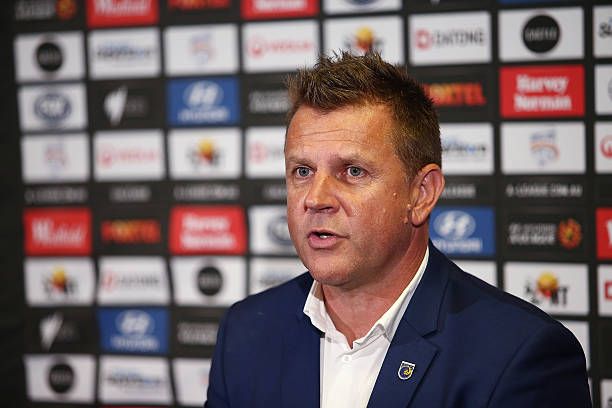

Across a career that has traversed continents, disciplines, and philosophies, Tony Walmsley has built a legacy defined not merely by titles or tenures, but by transformation. From the youth pitches of Manchester United’s international programs to the boardroom of Sheffield United, leading Central Coast Mariners to the humidity of Mumbai and now steering The Leaders Advisory, Walmsley’s path reflects an ongoing pursuit of understanding — of people, purpose, and performance.

At FieldVision, we had the opportunity to speak with Tony Walmsley, whose extensive experience in youth development and leadership continues to inspire the next generation of football thinkers.
On Evolving His Coaching Philosophy
Having worked across continents and cultures, Tony Walmsley has seen his coaching philosophy evolve from an idealistic pursuit of beauty to a pragmatic understanding of context.
“I’ve always seen football as an art form — when it’s played at its best, it’s a thing of beauty,” he reflects, describing a lifelong fascination with the aesthetics of the game. “Attacking football and the freedom to express yourself have always been at the heart of how I see the game.”
Yet, experience, he admits, has a way of reshaping even the most deeply held ideals. “You learn that while those philosophies are wonderful, reality sometimes demands something different,” he says. “I no longer walk into a role with a fixed philosophy. Instead, I ask — what does this culture need, and how can I be the right coach for it?”

Today, Walmsley’s outlook is anchored in adaptability and empathy — principles he believes are essential for modern leadership. “Adaptive leadership is everything,” he emphasizes. “It’s about meeting players where they need you to be. I’m not the kind of coach who insists my way is the only way. I’d rather shape my leadership to fit the environment.”
The Coaching Journey
Walmsley’s journey through football management reads like a masterclass in development, adaptability, and reflection. Before his stints with Central Coast Mariners and Sheffield United, he had already built an impressive résumé — from leading Manchester United’s international youth development program in Oceania to managing elite women’s football at the New South Wales Institute of Sport in the mid-’90s.
“At Manchester United, the goal was to identify and recruit world-class talent from Oceania,” he recalls. “It was during a time when players like Harry Kewell and Mark Viduka were flying high in the Premier League, and United wanted to tap into that Australian potential.”
His first tenure at Central Coast Mariners, where he established the club’s youth academy, remains one of his proudest chapters. “We created something special there,” he says. “We managed to recruit top young players, many of whom made it to the first team. Matthew Ryan, Mitchell Duke, and several others went on to play international football. That’s what it was all about — identifying talent, nurturing it, and watching it flourish.”
The success of that system earned him a move to Sheffield United as Head of Recruitment — a shift from the touchline to a more strategic role. “It was the first time I stepped away from the pitch,” he explains. “My focus turned to building a modern talent management process — from identification to recruitment, retention, and trading. I learned an enormous amount during that time.”
Walmsley would later return to the Mariners as head coach, a tenure that tested his resilience and perspective. “It was the most challenging period of my career,” he admits. “But the toughest moments are where you grow — not just by enduring them, but by reflecting deeply and making changes.”
Even now, years later, coaching remains in his blood. “I still coach — I’ve been with the same women’s team in the UK for four years,” he says with a smile. “Whether it’s professional men or aspiring young women, my approach never changes. The game’s the game, and players are players.”
On What Drew Him to India
For Walmsley, the decision to come to India wasn’t just professional — it was driven by ambition and curiosity. “It was aspirational,” he begins. “I saw opportunity, and I’ve always been drawn to complex, large-scale challenges. India felt like one of those places where something big and meaningful could happen.”

At FCV Academy in Mumbai, what first caught his eye was something as simple as the setting. “We had a grass pitch in the middle of Mumbai — which is rare,” he recalls. “That alone told me there was potential. The vision for the project was fantastic. Unfortunately, I fell ill before I could truly embed myself in it.”
Before his India venture, Walmsley had already explored football development projects in China as Technical Director for Tranmere Rovers’ academy program. “Both China and India were full of promise,” he says. “They were early-stage projects, bursting with potential. But then COVID arrived and disrupted everything. By that time, I’d already begun shaping The Leaders Advisory.”
Despite the setbacks, his enthusiasm for India hasn’t faded. “I wanted to go to India to experience it — to feel it, to taste it, to understand it,” he commented. “That ambition still drives me today. The vision and hunger are still there — and thankfully, so is the health to chase them.”
Bridging the Gap: The Leaders Advisory
After returning from a stint in India, Walmsley found himself at a crossroads. “I was unwell for quite a while,” he shares. “I didn’t have the capacity to go straight back into football, so I created The Leaders Advisory.“
The project is built on a simple premise: the lessons learned in high-performance sport are universally transferable.
“Whether it’s sales, startups, or sport — everyone’s chasing results and depending on people to deliver under stress. Whatever field you’re in, it’s a people game.”
Walmsley developed SCORE, a profiling program designed to decode team behaviors. “If a team collapses under pressure or leans too much on personal ambition, that’s insight into how leadership should respond,” he notes. His goal is to help leaders navigate the volatile space between where they are and where they want to be—maintaining composure when “plans collapse and pressure mounts.”
The Indian Paradox
Walmsley’s time at the FCV Academy in Mumbai was short—just three months—but it left a lasting impression regarding the state of Indian football.
The potential became obvious during his morning runs along Juhu Beach. “I saw kids from the fishing villages playing five-a-side on the sand… They had real talent — raw, unpolished, but natural,” he recalls. “That’s where I saw both the challenge and the opportunity.”
The Challenge? A “huge gap” between top-tier investment and the grassroots. While clubs and brands invest heavily at the professional level, Walmsley questions where the next generation is coming from.
He draws a sharp parallel to Australia: “In Australia, the better you are, the more expensive the game becomes… If football starts going that way in India, it risks losing kids who can’t afford to play.”

He goes on to point what Indian Football should focus more at this crucial juncture.
- Redistribution of Wealth: Moving focus from the top to development programs. “If all the money goes to the top, it’s hard to get the kid from a fishing village into the game.”
- Finding an Identity: “India needs to find its own football DNA—a style and structure that reflect its culture, geography, and people,” rather than copying European models.
- Unified Narrative: A single story from top to bottom, avoiding political barriers or competing leagues. “At one point there were two premier leagues competing for space and airtime”, he recalls.
- Local Coaching: Upskilling local coaches rather than relying on transactional overseas expertise. “There are lots of dedicated, willing coaches in India. Bringing in overseas expertise has great value, but the motivation and the legacy they want to leave matter. “
“There’s incredible potential in India. It just needs the right eyes, the right system, and the right support to bring it through.”
Lessons from Down Under: The Australian Evolution
Building a sustainable pathway in Australia took a 20-year cycle. For Walmsley, success comes down to managing ambition: “It’s about having a vision for the national team while dealing with the reality of where we are. Leading that process means identifying the right people who are committed for the long term.”

He witnessed the transition from community-owned ethnic clubs to the professional model of the A-League. “When I first arrived in Australia, the game was very much tied to national identities — Greek clubs, Italian clubs, Croatian clubs, even English clubs,” he recalls. Clubs lost their long built national identity, their fans and that was a real hurdle.
Despite these growing pains, the foundation was being laid for long-term progress. “Australia improved youth development while competing for attention with other popular sports. Football had high grassroots participation. Growing the numbers and building a sustainable pathway took a 20-year cycle.”
The Central Coast Mariners Trial
Tony Walmsley’s tenure at the Central Coast Mariners was marked by immense challenges, both on and off the pitch. Walmsley’s leadership theories were forged in the fires of the Central Coast Mariners. Taking the head coach role with his “heart rather than his head,” he faced a club struggling for survival and a squad with “toxic elements.”
“The club was struggling to survive. I initially took over as caretaker. The plan was to help the club appoint someone else. But the candidate didn’t meet the pro license requirements, so the club offered me the head coach role.”
The difficulties ran deeper than anticipated. “Within the group, there were some forces that were breaking down any attempt to build a new identity. Had we finished the season with the squad we started with, we probably would have been mid-table. But cutting ties with certain players was unavoidable. In a salary cap league, paying someone out of contract limits your ability to bring in new talent. So we had to rely on players on very low-cost contracts, and their willingness and attitude were tested to the extreme.”

The pressure was relentless, “After one game at Sydney Football Stadium, I was asked live on TV if it was time I resigned.” But there were moments of magic. “I remember being 2-0 down against Sydney FC and coming back to draw 2-2 at home… The lessons in leadership and resilience have been invaluable.”
A Pioneer in Women’s Football
Long before the current boom in women’s sports, Walmsley was breaking ground. In the mid-90s, he was the first full-time elite women’s coach in New South Wales, overseeing the development of future Olympians, all the way from the senior level to under-16s.
“We had an elite program—but the players were funding themselves,” he remembers.
Contrasting that with today’s fully professional landscape, he sees phenomenal growth but notes that a gap remains between the elite and the rest. For Walmsley, the key lies in patience and structure. “The long game is to keep promoting participation and developing coaches. Once the grassroots-to-elite pathway is strong, standards will rise naturally.”
The Digital Touchline: Technology, Data, and AI
Walmsley is also looking forward, exploring the intersection of technology and football. While GPS and physical load monitoring are commonplace, he sees the “next frontier” in understanding the minds of players. “Understanding a team’s makeup in terms of personality and performance is a game-changer. I’m not talking Myers-Briggs here — I mean a performance profile that tells you how to approach a player before a game to get the best out of them.”
He champions tools like SmartAI to personalize training and accelerate learning. “Adjusting training to the needs of the individual has a bigger impact than ever,” he says.
However, he offers a crucial caveat: “Analytics and AI are here to stay… But they’ll never replace the emotion, energy, and nuance of human interaction. A coach putting an arm around a player or challenging them in the right way — that’s irreplaceable.”
The Enduring Love of the Game
Stripping away the structures, business pressures, and systems, Tony Walmsley’s love for football remains deeply personal and enduring.
“When I first stepped out of football in 2012… I realized I wasn’t in football simply because I couldn’t not be — I was driven by helping other people reach their potential,” he reflects.

From watching his first Manchester United game with his dad to navigating the highs and lows of professional coaching, the game keeps pulling him back.
“I’m still coaching, still an avid consumer of football… I don’t think I’m finished with football. There are opportunities around me that excite me. I love it. Plain and simple.”
Beyond the Touchline
Tony Walmsley’s journey, from grassroots football to global leadership consulting, is a testament to the power of adaptability and self-awareness. His story is not just about the evolution of a coach, but the maturation of a thinker — someone who sees football not as an end, but as a mirror reflecting how people learn, lead, and grow together.
As the lines between sport, business, and leadership continue to blur, Walmsley’s perspective feels both timely and timeless. “Whether in football or in life,” he says, “it always comes down to people — how we connect, how we grow, and how we bring out the best in each other.”



Leave a Reply